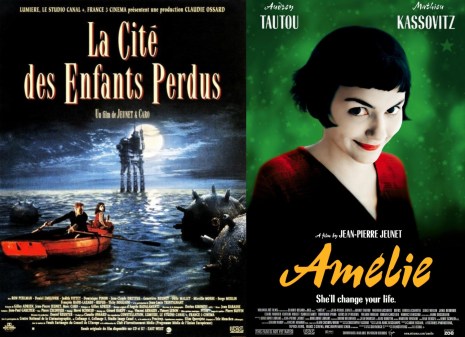
Directed by: Marc Caro [1], Jean-Pierre Jeunet [1, 2] || Produced by: Félicie Dutertre [1], Jean-March Deschamps, Claudie Ossard [2]
Screenplay by: Giles Adrien, Jean-Pierre Jeunet [1], Guillaume Laurant [2] || Starring: Ron Perlman, Daniel Emilfork, Judith Vittet, Jean-Claude Dreyfus, Geneviève Brunet, Odile Mallet, Mireille Mossé [1], Serge Merlin, Dominique Pinon, Rufus [1, 2], Audrey Tautou, Mathieu Kassovitz, Lorella Cravotta, Jamel Debbouze, Claire Maurier [2]
Music by: Angelo Badalamenti [1], Yann Tierson [2] || Cinematography: Daurius Khondji [1], Bruno Delbonnel [2] || Edited by: Ailo August [1], Hervé Schneid [1, 2] || Country: France, Germany || Language: French
Running Time: 112-123 minutes || 1 = The City of Lost Children, 2 = Amélie
For a good while, one of the trendiest pieces of French cinema in the West was the new millennium Amélie (French = “Le Fabuleux Destin d’Amélie Poulain,” or The Fabulous Destiny of Amélie Poulain), a magical realist romantic-comedy that exemplifies, to this day, the identifiable French New Wave legacy of self-reflexive storytelling (see Jean-Luc Goddard’s Breathless [1960] & Pierre le Fou [1965]), charismatic montage techniques (see Gaspar Noe’s Irréversible [2002] & Enter the Void [2009]), and genre twists to otherwise archetypal dramatic narratives (see Julia Ducournau’s Raw [2016] & Titane [2021]). Amélie is far and away the most successful venture of its director, Jean-Pierre Jeunet, who first cut his teeth on surrealist genre-hybrids like Delicatessen (taken from the German loanword of Delikatessen, or “Deli” in English; 1991) and The City of Lost Children, but whose career has never recaptured that glory in the four features he’s directed since, as of this writing (the 2022 science-fiction black comedy and Netflix Original Film, Bigbug, was his first major project in almost 10 years).
I and many US cinephiles who came of age in the late 1990s-2000s first knew of him as the wacky mind behind the wacky tonal mess that is Alien Resurrection (1997), by far the goriest and weirdest of the original Alien franchise (1979, 1986, 1992) and thus far Jeunet’s lone Hollywood production. Watching the films that immediately preceded and followed Resurrection, The City of Lost Children and Amélie, respectively, helps put that bizarre sci-fi monster-movie in context and allowed me, for one, to better appreciate Jeunet’s directorial style in its natural French-language environment.
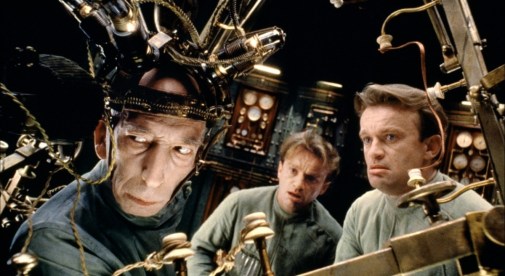
At the start of The City of Lost Children, Daniel Emilfork emerges from an invasive “dream session” with a kidnapped child while under the observation of multiple cloned Dominque Pinons.
For starters, Lost Children is a sort of dour, dark take on the steampunk aesthetics common to various Studio Ghibli films or Victorian-Era popular culture icons created by Jules Verne, Mary Shelley, H. G. Wells, etc., set in an unspecified French-speaking port city populated by various poverty-stricken Dickensian stereotypes and apparently stuck under perpetual nighttime; the city’s orphaned street children are prey to the likes of gangs run by nightmarish conjoined twins (Geneviève Brunet and Odile Mallet) as well as the narrative’s chief antagonist, Chilean-French actor Daniel Emilfork, the latter of whom kidnaps minors to steal their dreams via a sort of pre-Matrix (1999)/Inception (2010)-style psychological torture from his secretive layer within an offshore oil rig.
The visual direction of Lost Children, including its immaculate set-designs, unforgettable costumes, and overall creative art style, is the star, while the cast somewhat pail in comparison whether they’re sympathetic (e.g. Ron Perlman, Judith Vittet), villainous (e.g. the aforementioned Brunet, Mallet, and Emilfork), or somewhere in between (e.g. longtime Jeunet-collaborator Dominque Pinon). Pinon’s multiple over-the-top roles wear out their welcome by the beginning of the third act, while Perlman’s limited proficiency in French begs the question as to why he was cast as the film’s lead to begin with.
Stronger in terms of characterizations yet way more flamboyant cinematographically is the aforementioned Amélie, which most audiences embraced for its quirky optimism and feelgood romantic storytelling, a heavy contrast from the weird darkness of Lost Children. What holds back this “modern French classic” for me is its plethora of Family Guy (1999-)-esque cutaway gags (e.g. fifteen Parisian couples orgasming amidst a random voiceover), repetitive sequences with Serge Merlin’s “Glass Man” (an inspiration for M. Night Shyamalan’s Unbreakable [2000, 2016, 2019], perhaps?), and a bloated two-hour runtime. Many of the attributes of, say, Everything, Everywhere, All at Once (2022) and similar absurdist cinema (e.g. Brazil [1985], Synecdoche, NY [2008], The Lobster [2015]) that many audiences love, like hyperactive editing, cartoony art styles, and melodramatic, quirky characters I can swallow in small doses only, and the same dynamic applies in Amélie.
The film’s premise of a cartoony, larger-than-life everygirl next door (Audrey Tautou; note the contradictions) who decides to help her Parisian neighbors, friends, and family with random yet surgical acts of kindness is sweet, I suppose, with our main character finding love for herself as well in the end. Similar to All at Once, I found the extreme style of everything (… everywhere, all at once?) more overindulgent than charming at a certain point. Had Jeaunet streamlined the greater narrative, filtered down the giant cast, and honed the jokes into a cohesive 90-minute movie, I would’ve been on board.
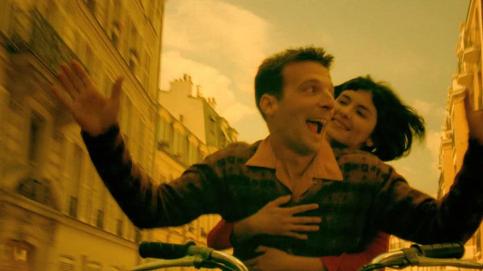
Amélie — surprise! — ends happily with its lead starlet having found true love with costar Mathieu Kassovitz.
Wes Anderson and Edgar Wright, whose styles appear reminiscent of peak Jean-Pierre Jeunet, seem to have distilled the latter’s neo-French New Wave aesthetics into screenplays I find far more palatable either in terms of structure, likable characterizations, cinematic humor, or all the above. I appreciate the romantic creativity and impact of Amélie while still favoring the unique visuals and storytelling nuance of his earlier City of Lost Children; the diegetic ambition of the latter outweighs the quirky humor of the former, regardless of their contrasting financial returns (Lost Children was a box office bomb while Amélie made over $174 million on a $10 million budget), showcasing the power of 1990s analog technology to create believable fantasy.
———————————————————
SUMMARY & RECOMMENDATION: If Alien Resurrection is Jean-Pierre Jeunet at his most mismatched (that film’s script is credited to Joss Whedon, of all people), then The City of Lost Children is him at his most balanced — a function, perhaps, of his shared directorial credit with Marc Caro — and Amélie, his most eccentric. I find the latter remains overrated to this day a la similar magical realist or absurdist cinema, styles that I feel get significant applause for random gags that translate well to viral Internet memes but are disconnected from their parent narrative.
— However… The City of Lost Children’s characters are stock archetypes at best, while Ron Perlman’s ostensible lead status is puzzling given his questionable command of the film’s language. As repetitive as I find certain aspects of Amélie, its comedic precision is admirable.
—> I RECOMMEND Lost Children but remain ON THE FENCE with respect to Amélie.
? Paris may be The City of Lights in Amélie, but it’s also The City of Darkness in John Wick 4 (2023)!

 Express Elevator to Hell
Discussion
Trackbacks/Pingbacks
Pingback: ‘Kiki’s Delivery Service’ (1989): You Can’t Go Home Again | Express Elevator to Hell - August 21, 2023
Pingback: ‘Chungking Express’ (1994): Dreams Don’t Make Sense, & Neither Do Wong Kar-wai’s Love Stories | Express Elevator to Hell - August 22, 2023
Pingback: ‘A Place to Fight For’ (2023): Where Romance Meets Crime Drama | Express Elevator to Hell - February 23, 2024