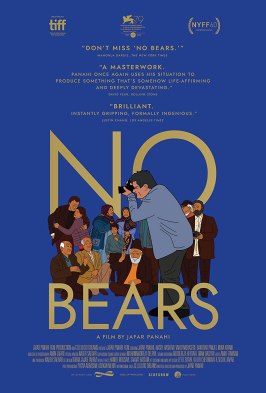
Directed by: Jafar Panâhi || Produced by: Jafar Panâhi
Screenplay by: Jafar Panâhi || Starring: Jafar Panâhi, Naser Hashemi, Vahid Mobsari, Bakhtiar Panjei, Mina Kavani, Reza Heydari
Cinematography: Amin Jafari || Edited by: Amir Etminan || Country: Iran || Language: Persian, Azerbaijani, Turkish
Running Time: 107 minutes
A commentator on Glenn Kenny’s review of No Bears for RogerEbert.com summed up my general thoughts on the state of Iranian (Persian) filmmaking since the 1979 Revolution: It is amazing to me that Iran has a film industry. In comparison to the lucrative blockbuster machine of the People’s Republic of China, perhaps the existence of a national Persian moviemaking culture shouldn’t come as a shock, but comparisons of the films produced between these two authoritarian states rife with artistic censorship laws exemplify as many fundamental cultural differences as they do coincidental overlap in antidemocratic norms. China’s modern film industry is more akin to the nationalist propaganda of communist (e.g. the Soviet Union) or fascist (e.g. Nazi Germany) governments of yesteryear backed by considerable geoeconomic engines, while cinematic arts that flourish under the Islamic Republic of Iran recall the works of regional peers like Lebanon (e.g. Nadine Labaki) or Saudi Arabia (e.g. Haifaa al-Mansour); the former type of film industry is an unofficial arm of the repressive state and the latter is a rebellious subculture that is intermittently tolerated by the repressive state.

With some exceptions, actors talking straight to camera is one of my biggest pet-peeves as a cinephile. The extended monologue of Iranian expatriate, Mina Kavani, is probably the low point of No Bears, for me.
Jafar Panâhi, the Persian auteur behind last year’s festival favorite of No Bears, represents an interesting case study of an artist flourishing under the bizarre, almost contradictory circumstances of that second type of authoritarian rule. Across a filmography of ten films thus far (circa July 2023), Panâhi has built an identifiable directorial style that combines true documentarian, docufiction, docudrama, and traditional narrative filmmaking conventions. His work involves indirect sociopolitical criticism like most of his Iranian peers, which may explain part of the appeal of post-1979 Persian filmmaking: Ballsy yet not preachy social commentary not only lessons the chance of state censorship but also respects one’s audience enough to trust they can read in between a film’s lines.
Still, any sort of transgressive work is a risk in an environment like Iran, and Panâhi has found himself on the wrong end of multiple feature-film bans (e.g. The Circle [2000], Crimson Gold [2003], Offside [2006]), official censures, arrests, and even imprisonments. The man was arrested by the authorities in 2010 for vaguely defined crimes related to his work and thereafter placed on house arrest, which was later relaxed, but also barred from leaving the country and forbidden from directing films for twenty years. Like any self-respecting artist, Panâhi has directed five features since that legal decision, including No Bears, all of which were filmed covertly and I assume smuggled out of the country through various means.
No Bears in particular is notable for how its festival and theatrical releases were overshadowed by its director’s latest arrest in July 2022 (Panâhi was eventually released in February of 2023 following a hunger strike), but its content and style appear par for the course for both its auteur and dramatic critical darlings in general. The sociopolitical background of its production I find far more interesting than the film itself, similar to how, say, the business side and behind-the-scenes controversies of Hollywood blockbusters are often way more entertaining than those blockbusters themselves.
If you’re familiar at all with Abbas Kiarostami’s work (Panâhi served as an assistant director on the latter’s Through the Olive Trees [1994]), then No Bears reads like a self-critique of the social commentary in films like Close-Up (1990) and Taste of Cherry (1997). The film stars Panâhi as a fictionalized version of himself attempting to make a film near the Iranian-Turkish border about a couple (Bakhtiar Panjeei and Mina Kavani) attempting to steal tourists’ passports in an effort to immigrate to Europe, but the content of said diegetic film is meant as a docudrama of the actual life history of the fictional “actors” within the film’s greater world (confused yet?). In other words, Panjeei and Kavani perform as nonprofessional actors for Panâhi’s autobiographical character in a film production that we, the viewers, watch; but that diegetic film production is meant as a reenactment of those former two characters’ lives. If you’re perplexed by the film-within-a-film storytelling and dislike actors monologuing directly into camera (see also Stalker [1979]), an additional subplot revolving around the fictionalized Panâhi wandering into a love-triangle amongst the local villagers of his location-shoot is a bit more interesting.
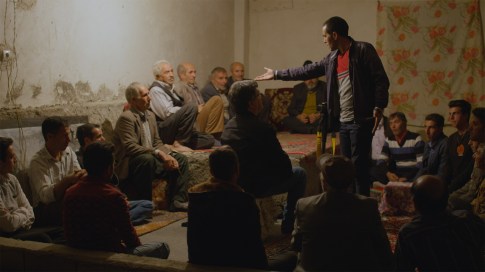
My personal favorite sequence of No Bears involves a sort of townhall meeting in the village where Panâhi shoots his film, where Panâhi must swear he has no documentation of an alleged affair within the community.
Panâhi’s direction of the aforementioned subplots alternate between long, subtle camera pans that cover an entire scene’s geography a la Roma (2018), static long shots filmed with stylized low-key lighting at night or overexposed setups during the day, and static ensemble staging captured at flat angles. For my part, I enjoy the first two techniques but found the latter inappropriate for this dramatic material, though occasional handheld tracking shots liven up the weird, unintentional comedy framings.
If you’re a fan of guerilla filmmaking, then you may have already seen and loved No Bears, or are about to see it and likely won’t be dissuaded by my lukewarm reaction; if, however, you’re the sort of cinephile skeptical of unanimous critical praise of these sorts of movies, then I’d wager you might not fall in love with Jafar Panâhi’s latest cinematic protest against the federal government of Iran. There’s more going on in this film than, say, Warriors of Future (2022) or The Wandering Earth (2019), and it’s not self-indulgent a la Alejandro Iñárritu’s masturbatory Bardo (2022), but a potent blend of political intrigue and genre style in the vein of Quentin Tarantino this is not. The story about this film’s writer-director after the film wrapped, though? A cinematic adaptation of that I would pay to see…
———————————————————————————————————————————————————————————
SUMMARY & RECOMMENDATION: At a modest 107 minutes and with minimal to no preaching, it’s hard to fault Jafar Panâhi’s cinematic focus in No Bears; his direction is eclectic enough to overcome his script’s disjointed subplots and, at times, muggy digital hardware, but I can’t help but feel the most captivating story would’ve been one metatextual layer outside of what we see on screen.
—> ON THE FENCE
? The bears may be imaginary, but the Revolutionary Guard are real!

 Express Elevator to Hell
Discussion
No comments yet.