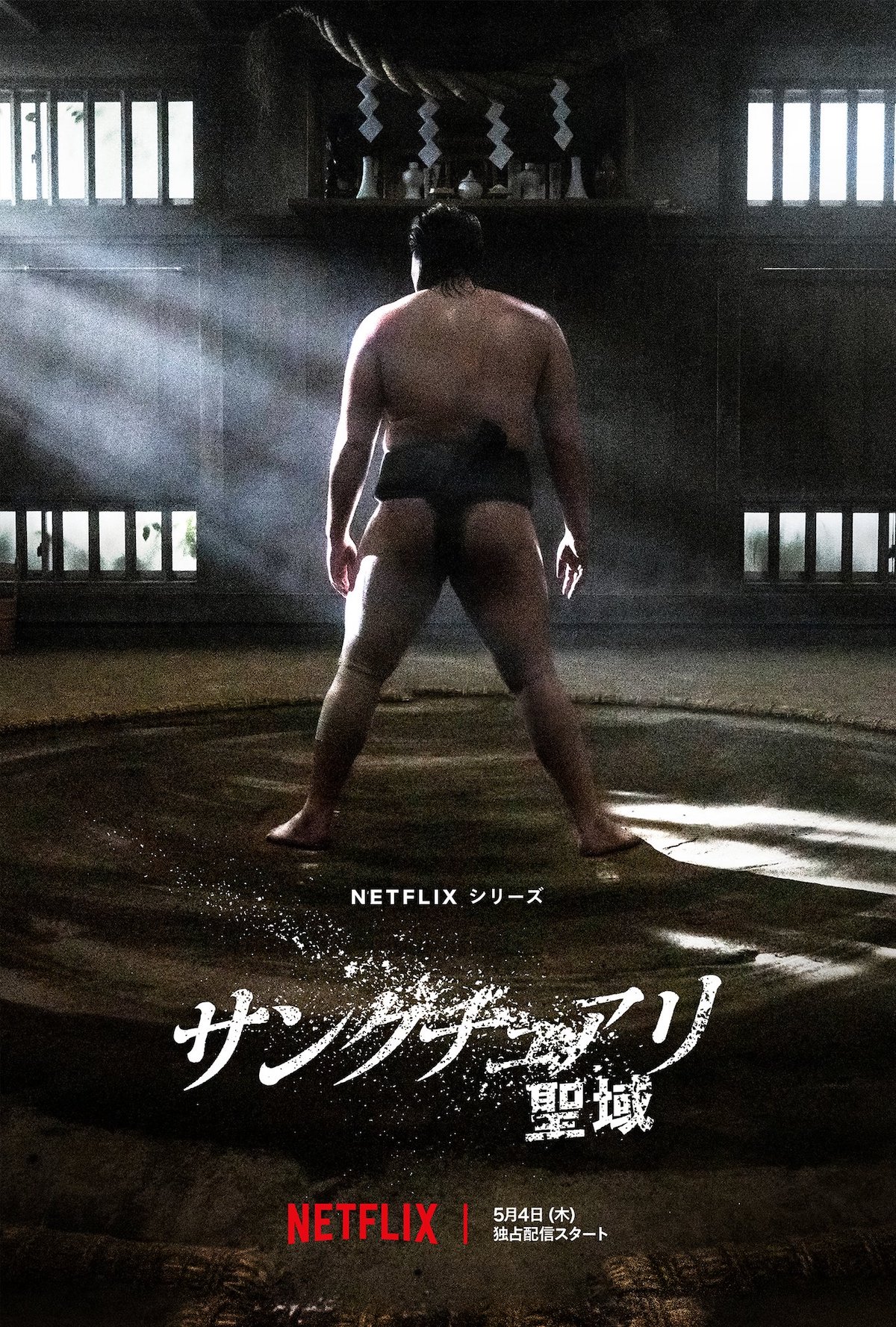
Created by: Kan Eguchi|| Written by: Kanazawa Tomoki
Directed by: Kan Eguchi || Starring: Wataru Ichinose, Pierre Taki, Shioli Kutsuna, Shōta Sometani, Hiroki Sumi, Koyuki Kato, So Kaku, Suzuki Matsuo, Tomorowo Taguchi, Kimiko Yo
No. of Episodes: 8 (~380 minutes total)
The dominant stereotypes I’d wager most Americans/Westerners have of the Japanese are their (1) affection for wacky, innovative animation, (2) hyper-efficient, clean urban metropolises, namely Tokyo, and (3) professional, posh, and slim stature. Examining the average heights of different East Asian nations and taking into consideration their varying levels of societal development and dietary preferences, citizens of the Land of the Rising Sun stand out for their modest size. Average male and female heights are 5′ 7.5″ (171.8 cm) and 5′ 2″ (158.6 cm), respectively, despite the nation-state’s wealth, high human development index, and homogenous ethnic makeup.
For those reasons, the international recognizability of sumo, or the competitive full-contact wrestling native to the island nation, stands apart from the bulk of cultural stereotypes most outsiders have about Japan. Rough, grimy, and dominated by larger individuals with body types more in line with gridiron football lineman than most other athletic builds, sumo possesses the sort of identifiable ethnonational “brand” comparable to McDonalds, Superman, or jazz music. Everyone knows what it is on a broad, superficial level, including its ties to a specific people or place unlike more popular sports like association football, baseball, or basketball, which have become international, if not universal activities.
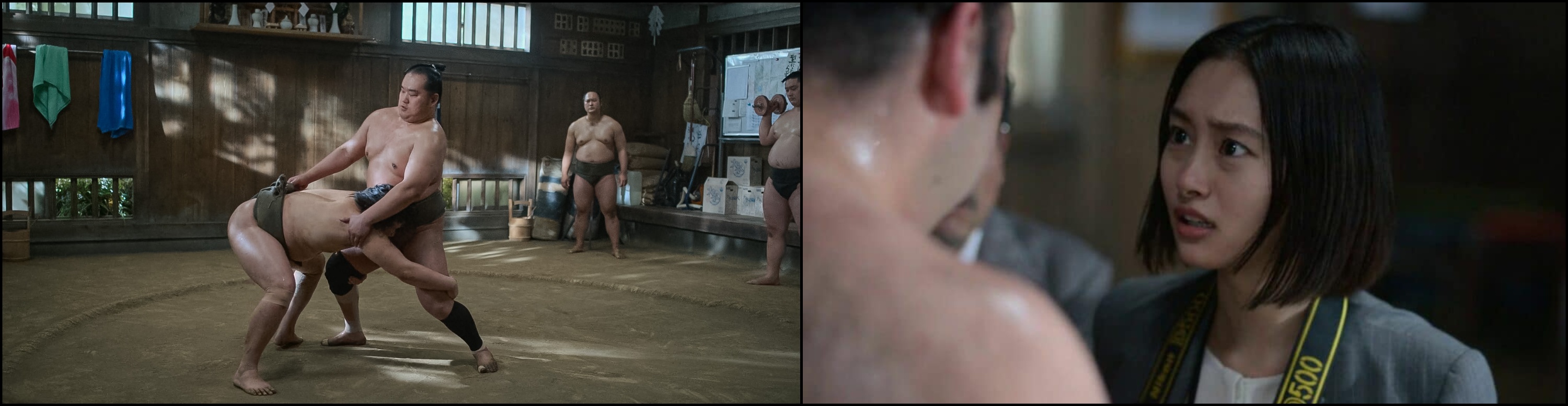
Left: Extensive portions of most episodes of Sanctuary involve main castmembers’ full-contact practice or strength and conditioning training. Right: Secondary lead and outsider Shioli Kutsuna stars as a progressive journalist raised abroad who clashes with sumo’s traditionalist, patriarchal structure.
Leave it to Netflix, then, to produce a self-contained series about the personal and professional growth of athletes within the sumo world. Centered around a classical down-on-his-luck protagonist and outsider to the sport (Wataru Ichinose), Sanctuary dunks its viewers head-first into this unique culture through a combination of nonlinear flashbacks and potent slow-motion photography. Its embrace of the grit of sumo won’t convert squeamish audiences into grappling fans, but its three-dimensional, well drawn lead and the contrast the show draws between him and his newfound profession lend universal relatability to the show’s character arcs.
With regards to direction, Sanctuary eschews dynamic handheld camerawork and most tracking camera movements in favor of colorful, detailed mise-en-scène captured by either stationary or slowly panning cameras. This disciplined cinematographic approach calms the aggressive physical action on display and allows the emotional, oftentimes tortured backstory flashbacks to breathe; the series might have the audiovisual style of a stage play were it not for its surgical application of ultrahigh framerate slow-motion, which emphasizes not just haymaker knockout blows and body slams but intricate sumo techniques at different stages of different matches. Matching these deliberate visual techniques are the casts’ memorable physical performances, all of whom take advantage of their wide range of distinct personalities.
With regards to writing and editing, Sanctuary’s personality is the sum total of its cast’s great chemistry and memorable on-screen development, aided most by well structured teleplays that establish their upbringing, personal insecurities, and career accomplishments. Wataru and main “antagonist”/rival Hiroki Sumi —a former sumo wrestler in real-life, mind you — command the bulk of these flashback sequences, but almost every character, minor to major, gets a moment to shine.
That dedication to developing a broad ensemble cast may be the source of Sanctuary’s few yet significant problems, in fact. Too much character development for the supporting cast outside of Wataru and Hiroki crowds the first 5-6 episodes, forcing the final 2-3 episodes to race to the finish line as less important subplots get dropped seemingly at random. Of particular note is the final episode, which, like the inexplicable conclusion to The Green Frontier (2019), runs only about 2/3 as long (32 minutes) as the rest of the series’ installments (~40-65 minutes per episode, on average) and cuts to black a la The Sopranos‘ (1999-2007) infamous final shot. I do not know whether the show’s rapid expansion and subsequent contraction in narrative scope resulted from a tight budget or simply idiosyncratic writing, but Sanctuary could’ve used further rewrites to focus its overall storytelling approach.
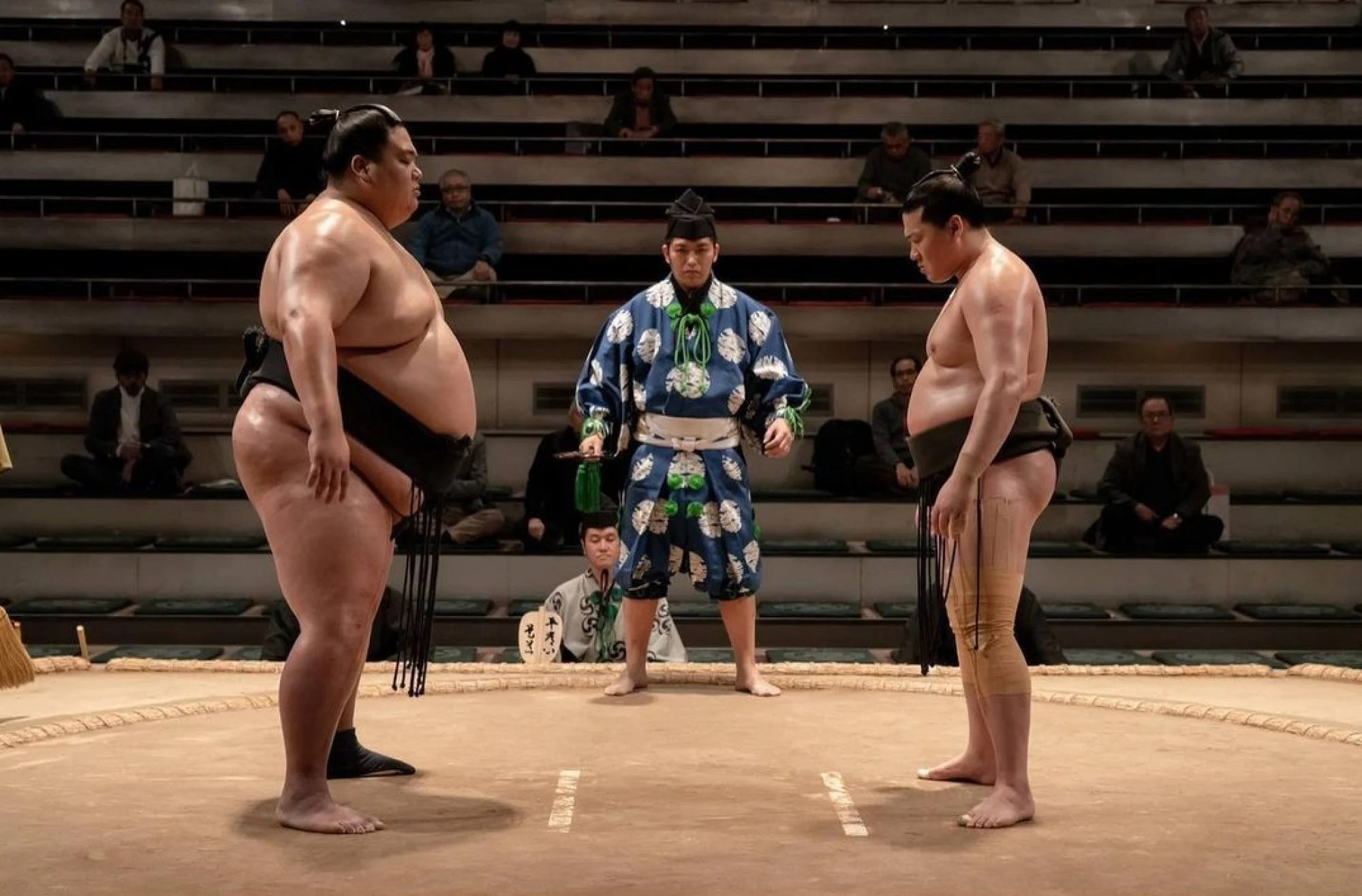
Mild spoilers: In the series’ final sequence, a matured, focused Wataru Ichinose (right) rematches with Hiroki Sumi (left), who annihilated him in an earlier bout.
Despite those weaknesses, Sanctuary, so named for the dohyō or ring in which sumo wrestlers compete, succeeds as a broad introduction to the sport’s culture. Its usage of character-driven rather than plot-driven screenwriting techniques to accomplish that is not a surprise, but its story loses focus thanks to attempting to develop almost every single character on screen. Fans of sports dramas and Japanese culture will find much to like here, and even viewers with little interest in either arena will be entertained by the memorable personalities on display, on the other hand. I, for one, enjoyed the cinematic exploration of one of Japan’s most recognizable yet perhaps least understood cultural touchstones, in part because I did not feel lectured to or bored by the series’ discussion of sumo. I will take that over a sanctimonious documentary any day.
————————————————————–
SUMMARY & RECOMMENDATION: Based around a classical misfit, fish-out-of-water protagonist, Sanctuary educates through emotional connection to its strong characters and entertaining, visceral cinematographic capture of brutal wrestling competitions. Its visual style is deliberate and identifiable thanks to its luscious mise-en-scène and memorable use of slow-motion photography, while all its characters have nothing if not personality.
— However… its large cast, while not inappropriate for an eight-episode limited series, are developed at the expense of a coherent overarching storyline. The final episode in particular feels abbreviated and rushed for no justifiable reason.
—> RECOMMENDED for sports fans, general audiences that enjoy worthwhile dramas, and of course fans of the grittier side of Japanese popular culture.
? Apparently, Hiroki Sumi’s competitive weight was 443 lbs (201 kg)!

 Express Elevator to Hell
Discussion
No comments yet.