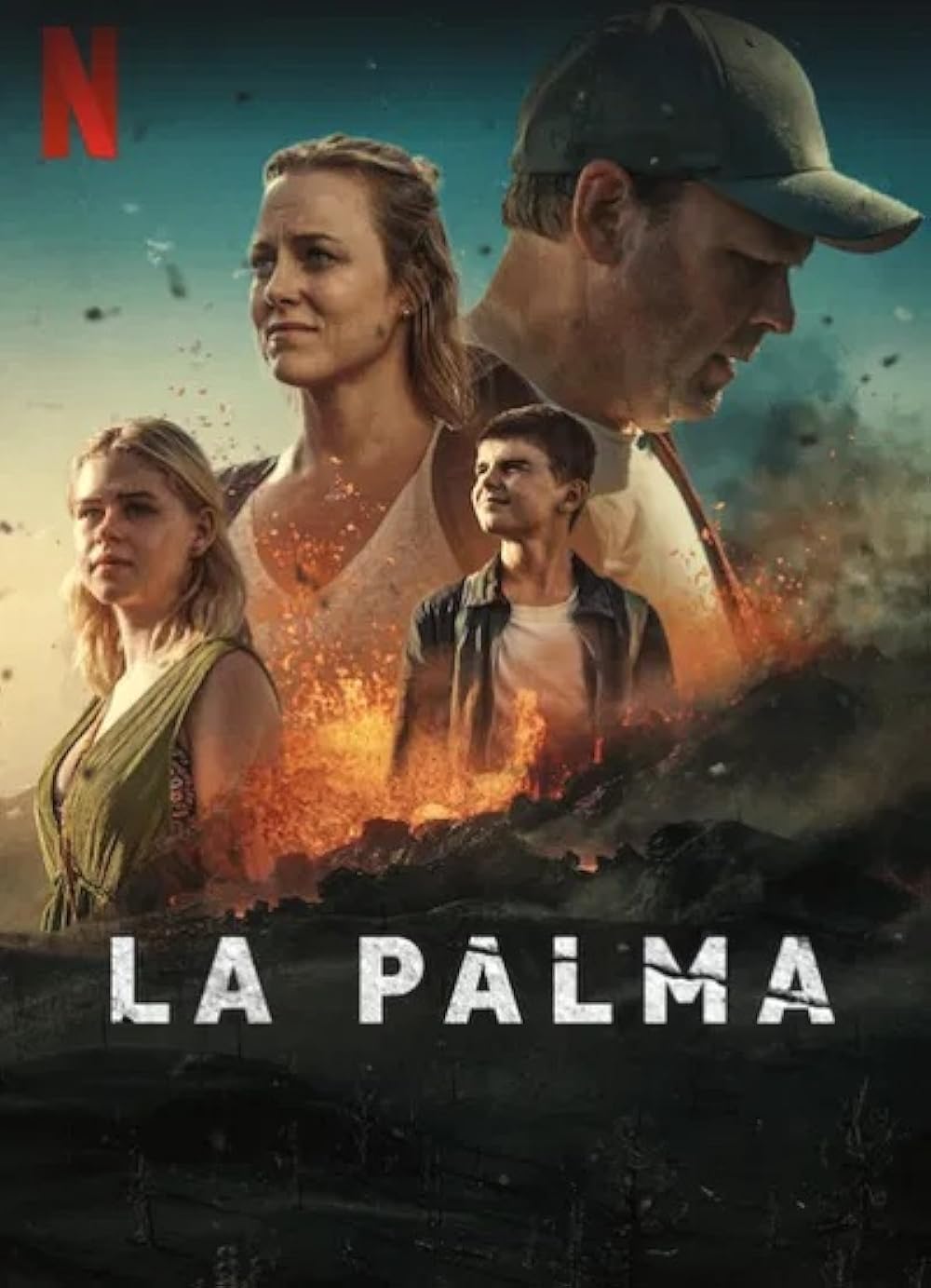
Created by: Martin Sundland, Lars Gudmestad, Harald Rosenløw-Eeg || Written by: Lars Gudmestad, Harald Rosenløw-Eeg
Directed by: Kasper Barfoed || Starring: Anders Baasmo Christiansenm, Ingrid Bolsø Berdal, Alma Günther, Thea Sofie Loch Næss, Bernard Storm Lager, Ólafur Darri Ólafsson, Jorge de Juan, Ruth Lecuona, Armund Harboe, Jenny Evensen, Iselin Shumba Skjæveslandn, Thorbjørn Harr
No. of Episodes: 4 (~180 minutes total)
One of the best, most efficient, and most satisfying disaster movies of the last couple decades is The Wave (2015) by Roar Uthaug. The slim, 105-minute Norwegian film, set and shot in the mountainous coastal town of Geiranger, stuck to the basics of disaster genre formula popularized by Hollywood hits of decades past like Deep Impact (1998) and Twister (1996). Relying on unembellished yet well realized characters, The Wave paced its seamless computer generated imagery (CGI) around minimalist character development as well as effective location-photography. It and its 2018 sequel, The Quake, directed by fellow Norwegian John Andreas Andersen, cut against the bloated melodrama of later Hollywood disaster filmmakers such as Roland Emmerich; the latter’s special FX, stock characters, and running times expanded out of control throughout the 2000s until the 2010s superhero blockbuster trend took them out for good.
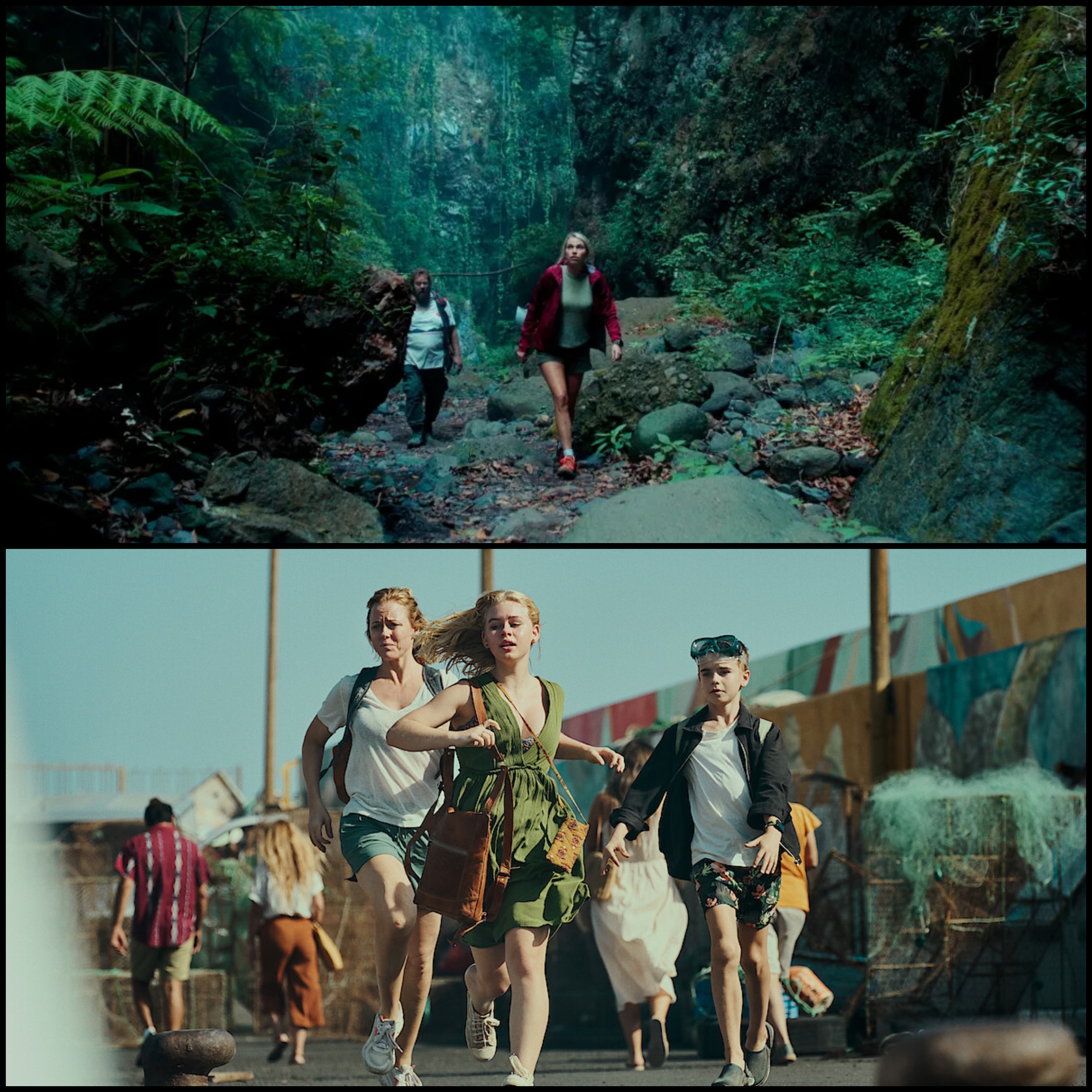
Top: Thea Sofie Loch Næss (right) and Ólafur Darri Ólafsson (left) star as geologists studying the volcanic activity of La Palma. Bottom: Our primary family unit of the miniseries, Ingrid Bolsø Berdal (center left), Alma Günther (center), and Bernard Storm Lager (center right) flee La Palma in the third episode. Father Anders Baasmo Christiansen (not pictured) is forced to find an alternative escape route.
Forgive me then, when another Norwegian production, disaster story, yet also Netflix Original series, La Palma, caught my eye last month. La Palma’s status as a limited or miniature series (miniseries) further convinced me to give La Palma a try, as its format assured me of a somewhat concise, completed story with a concrete ending.
Shot on the eponymous location and neighboring island of Tenerife in the Canary Islands, La Palma the show dramatizes the theoretical mass casualties from the hypothesized Cumbre Vieja tsunami hazard. Much like The Wave, La Palma takes inspiration from potential future natural disasters based on ongoing real-life geological studies: The miniseries analyzes what might happen should the Cumbre Vieja volcano on the titular island erupt and trigger a landslide into the surrounding ocean, which could, in turn, produce a massive tsunami a la Uthaug’s film.
To cut to the chase, La Palma is an overall worthwhile Netflix drama that pails in comparison to the aforementioned Norwegian theatrical features. I would ironically put the limited series on even footing with Uthaug’s own Netflix Original Film, Troll (2022), which might be the most critically overrated foreign/non-English language Netflix Original feature I’ve watched on the platform. La Palma has about as many structural weaknesses as it does strengths, the former of which have to do equally with characterizations and pacing.
With regards to positives, La Palma clocks at about 180 minutes across just four episodes, or around 45 minutes per episode. That’s refreshingly modest even by contemporary miniseries’ standards, but also begs the question as to whether La Palma should’ve been designed as a single feature. I would argue the episodic structure of La Palma aides its narrative pace, allowing the viewer to take breaks at appropriate peaks and valleys in the story’s tension.
Other strengths emerge in visual FX, editing, and overall directorial vision. La Palma showcases a massive volcanic eruption, a commercial airliner crash, a mountainous earthquake and subsequent landslide, and a tsunami in that order. All are convincing thanks to an admirable combination of brief yet high-quality CGI and memorable location-shooting; everything blends despite the constant high-key tropical daytime lighting. In addition, most set-pieces benefit from parallel edits that maximize tension and build narrative stakes from one disaster to the next.
All the above are undercut, however, by a slow buildup across the first two episodes, unnecessary personal backstory amongst the large ensemble cast, and one particularly tiresome romantic subplot. While The Wave and The Quake eschewed all character backstories that were not strictly necessary to advance their plots, La Palma dabbles too much in contrived personal arguments that manufacture uninteresting soap opera conflict prior to the principal natural disasters. The worst example of this is the teenage romance between main castmember Alma Günther and supporting actor Jenny Evensen, which the writers use to justify multiple sequences of characters needlessly endangering themselves. These and other uninteresting personal conflicts amongst the main cast slow the pace of the first half of La Palma, which might cripple the story were it not for that staggered episodic structure.
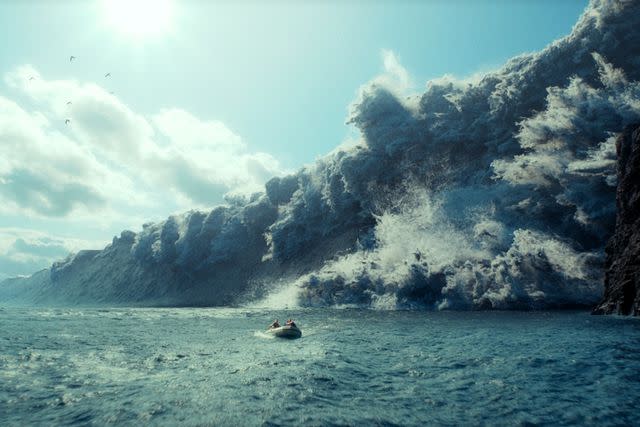
Christiansen and Loch Næss race to a sheltered cove as a gigantic wave threatens to consume them.
Top to bottom, there’s much to like about La Palma given its production values, limited series format, and succinct conclusion that avoids any prolonged epilogue. The bulk of the series’ problems stem from its deliberate opening act, which on the one hand make the eventual chaos in episodes three and four more satisfying, but on their own feel like checking formulaic boxes in ways that other Norwegian disaster movies never did. Put another way, La Palma’s characters work OK yet are not strong enough for the amount of dialogue and contrived melodrama that form the foundation of the series. La Palma still won’t cost you much given its modest episode count, and has enough creativity and production values to offer something to most audiences… and I would still rather watch The Wave and The Quake for the same rewards.
——————————————————
SUMMARY & RECOMMENDATION: La Palma has enough sense to save its memorable special FX for the appropriate narrative climaxes of its teleplays, expending most of its energy on establishing its setting and characters prior to the natural disaster mayhem. Thanks to effective parallel editing throughout, the series provides enough varying perspectives on its realistic conflict that said conflict feels epic without losing its human heart.
— However… La Palma’s human heart tends to annoy as often as it invigorates given how multiple supporting performances could’ve been excised and not lost the parent storyline any emotional impact. One notable romantic subplot in particular feels superfluous from both a character and plot development perspective.
—> ON THE FENCE
? It is unreasonable to not expect government workers to alert their family members with confidential inside information in a disaster scenario.

 Express Elevator to Hell
Discussion
No comments yet.