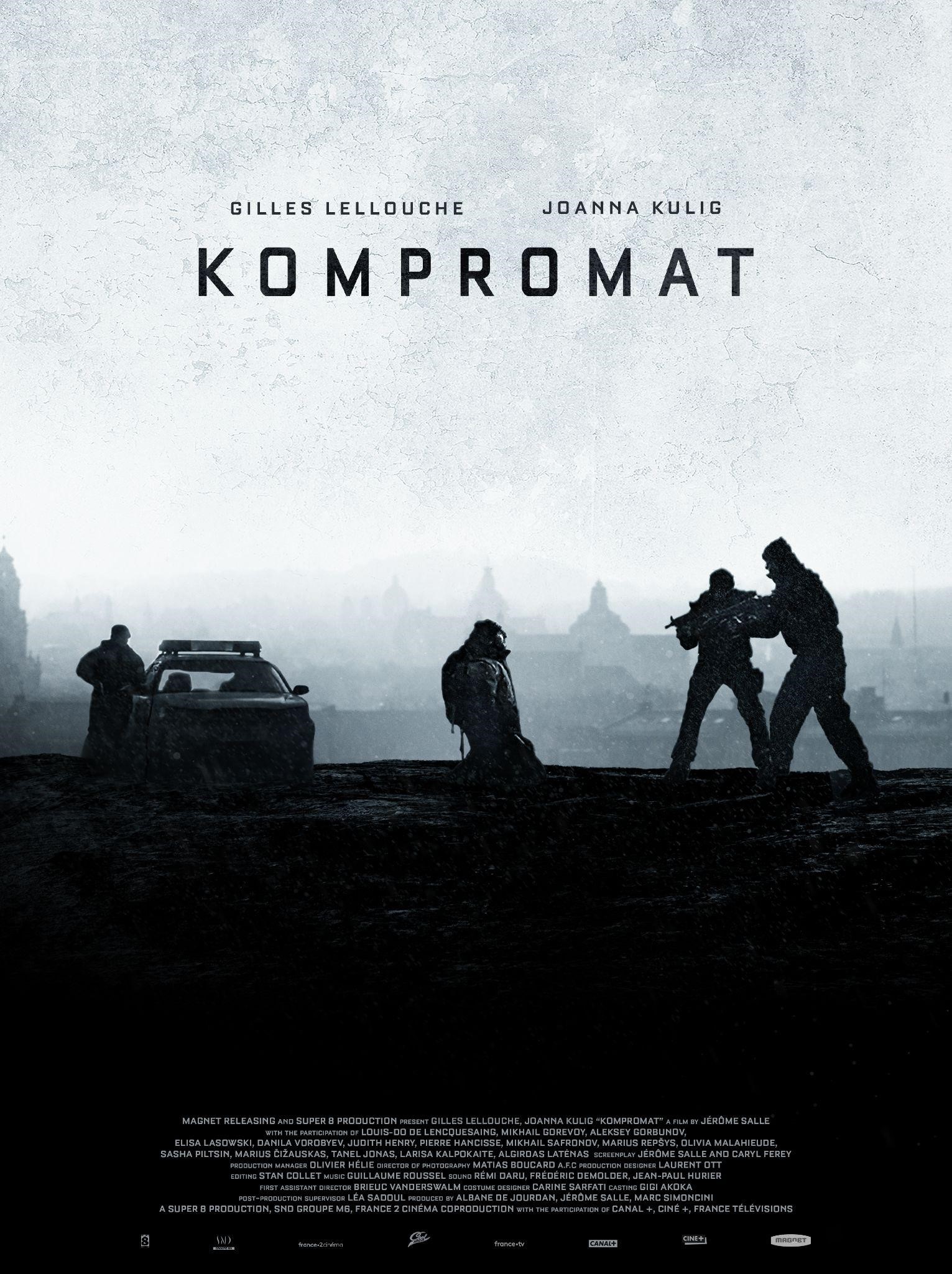
Directed by: Jérôme Salle || Produced by: Albane de Jourdan, Jérôme Salle, Marc Simoncini
Screenplay by: Jérôme Salle, Caryl Ferey || Starring: Gilles Lellouche, Joanna Kulig, Louis-Do de Lencquesaing, Mikhail Gorevoy, Aleksey Gorbunov, Elisa Lasowski, Danila Vorobyov, Judith Henry, Igor Jijikine
Music by: Guillaume Roussel || Cinematography: Matias Boucard || Edited by: Stan Collet || Country: France || Language: French, Russian
Running Time: 127 minutes
A well meant if inconsistent movie that summarizes my international travel fears is the French movie Kompromat. Loosely based on the real-life tribulations of one Yoann Barbereau, Kompromat describes the ultimate traveler’s nightmare for those who have ever visited an authoritarian state: Protagonist Gilles Lellouche, a French national working abroad under Alliance Française in the Siberian city of Irkutsk, becomes the target of the eponymous type of smear campaign by the Russian government. After negotiating his release from prison, Lellouche must decide whether to flee the country on his own by any means necessary.
There are many aspects to like about Kompromat, from its nuanced description of the Russian security state to its considerable main character development to its suspenseful editing techniques, but also just as many parts to dislike. I feel that Lellouche was both miscast and gives an inconsistent lead performance; the movie focuses too much on less interesting supporting characters, including a melodramatic romance subplot; and its over-the-top, genre-switching finale feels out of place relative to the rest of the story. In the end, Kompromat is an enticing yet frustrating movie that begs to be taken seriously given its numerous real-world analogues, all while unable to help itself from pandering to what I suspect were awards-bait or general audience ambitions.
Let us start with the good: Kompromat takes its time to establish Lellouche’s personality, professional background, and family life, all facets critical to his arc, in its tense opening act. Aside from the unnecessary, out-of-place prologue, the first 45-60 minutes are memorable thanks to well edited flashbacks, intimidating extras, and genuinely upsetting sequences like the arrest of our protagonist and his subsequent transfer to prison. The physical backdrop of Lithuania, most of all, emphasizes the intense cold and overcast mood of the narrative as effectively as any castmember or chase sequence.
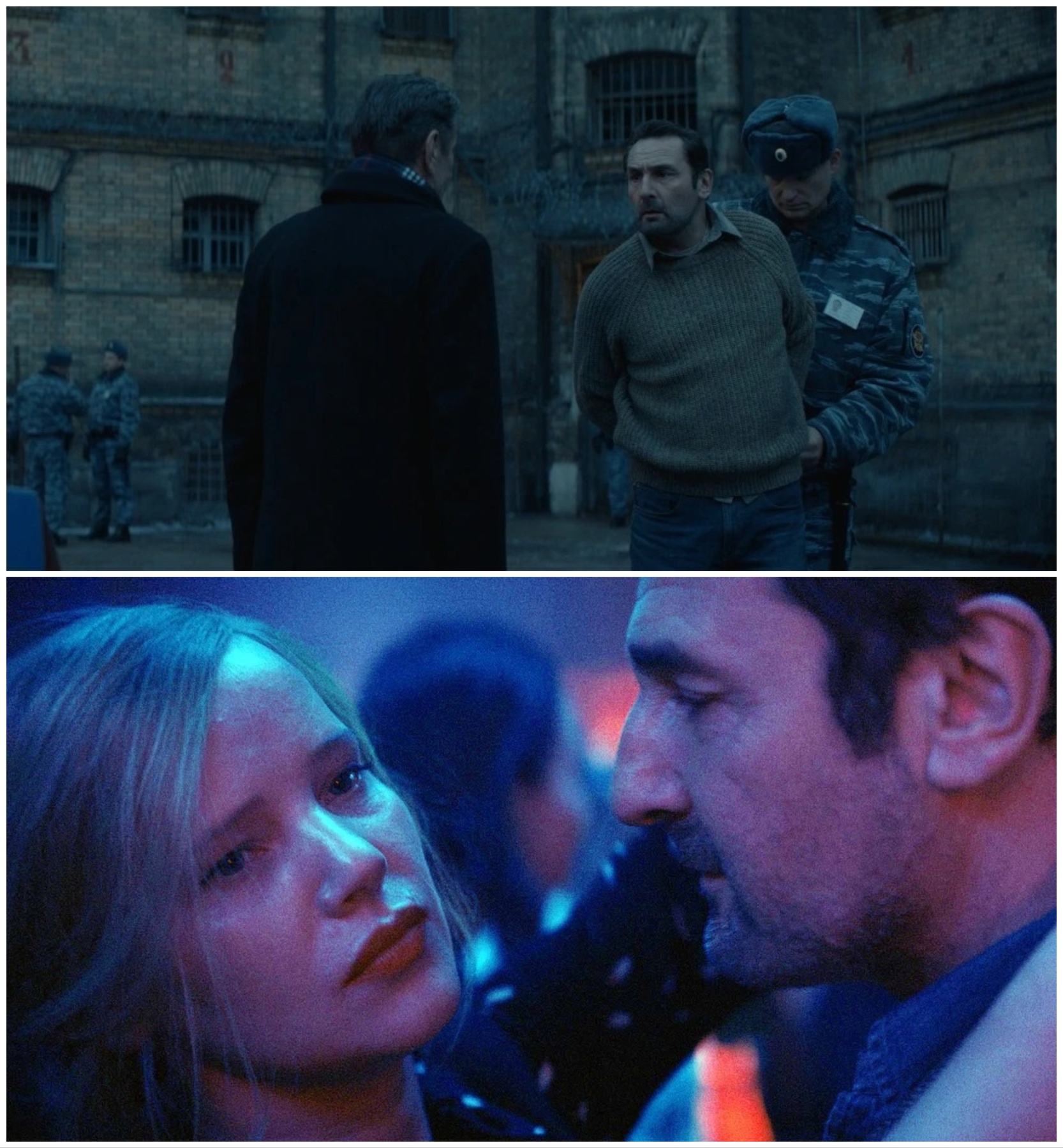
Gilles Lellouche is placed under arrest and sent to prison (top) after being caught committing multiple “crimes,” one of which is dancing in public with the daughter-in-law (Joanna Kulig; bottom) of a local Federal Security Service officer.
On the other hand, the tone of Krompomat is all over the place; it transitions from a cruel political drama to a somewhat grounded action thriller, then morphs into a romantic melodrama with female lead Joanna Kulig, and finally closes with a clumsy, histrionic fist-fight between Lellouche and secondary antagonist Igor Jijikine (the big Russian guy from Kingdom of the Crystal Skull [2008]). Accentuating this narrative confusion is the lead performance of Lellouche himself, who both feels miscast (he works as an older, grizzled narcotics officer in The Stronghold [2020], not as a younger, pacifist family man in touch with his feminine side) and like he’s acting in the wrong movie, depending on the scene. His portrayal of a civilian cultural scapegoat of the Russian Federation ranges from relatable and sad to tedious or even cheesy.
Top to bottom, Kompromat is similar in genre format, visual style, and subject-matter to another French melodrama with real-life inspirations, A Place to Fight For (2023). The main difference between them is that the latter, which dramatizes how an undercover police officer (François Civil) becomes romantically involved with one of his leftist-anarchist targets (Lyna Khoudri), is led by well cast, charismatic lead performances and feels grounded in reality throughout its story. Kompromat, by contrast, starts as a cold, calculating, rather scary political thriller, but meanders into a theatrical romance that feels tangential to the screenplay’s primary focus. Unlike A Place’s memorable yet not flashy tracking camerawork, Kompromat’s cinematography devolves into a low-grade Bourne (2002, 2004, 2007) action flick late in its third act, sealing the deal on this otherwise entertaining tonal mess.
——————————————————————————————————————————————————————————
SUMMARY & RECOMMENDATION: A large part of me still likes this movie and wants to recommend Kompromat to certain audiences, but its wacky final act and inappropriate tonal shifts rubbed me the wrong way. More than enough bigger-budgeted (e.g. Steel Rain [2017]) or more impactful (e.g. The Endless Trench [2019], Jogi [2022]) thrillers with mild to heavy dramatic political overtones are available to those who want them. To be sure, Kompromat is not as sloppy or as heavy-handed as, say, Khufiya (2023), but that’s not much of an argument in its favor.
— However… the first half and the first act in particular are riveting stuff. The cold, harsh location-photography of Lithuania adds much to the film’s oppressive atmosphere and helps sell Gilles Lellouche’s despair.
—> Kompromat is NOT RECOMMENDED given how I can only get behind 1/3 to 1/2, at the most, of a good film (see also High Tension [2003]).
? Do Russians actually look down on dads if they play princess with their *daughter*?

 Express Elevator to Hell
Discussion
No comments yet.