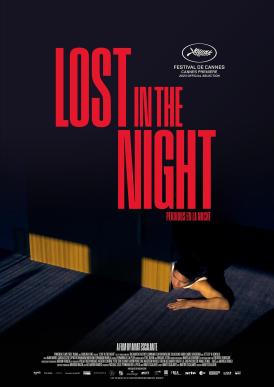
Directed by: Amat Escalante || Produced by: Nicolás Celis, Fernanda de la Peza
Screenplay by: Amat Escalante, Martín Escalante || Starring: Juan Daniel García Treviño, Ester Expósito, Bárbara Mori, Fernando Bonilla
Music by: Kyle Dixon, Michael Stein || Cinematography: Adrián Durazo || Edited by: Fernanda de la Peza || Country: Mexico, Germany, Netherlands, Denmark || Language: Spanish
Running Time: 122 minutes
Much of the time, independent or chump-budgeted film productions are lauded on principle for executing a filmmaker’s vision on limited resources. The less expensive a film is, the less studio or producer-level oversight tends to “interfere” with a director’s artistic intent and the more creative successful production teams have to be to complete their feature. As such, independent films completed with modest narrative scope or as intimate dramas tend to attract significant critical adulation even if said films’ stories aren’t too memorable or “cinematic” years down the line; it is an understandable if questionable double-standard against which I have long argued despite my own exhaustion with big-budget major studio productions whose opposite philosophy of “bigger is always better” irritates me in a different way.
Sometimes, a spade is just a spade, or rather, sometimes an artsy, auteur-driven independent drama is just boring and forgettable in spite of or perhaps because of its considerable budgetary limitations. Feature-films of even modest aspirations require considerable resources for which filmmaker ambition cannot always compensate.

A great way to deal with problems with your significant other in Lost in the Night is to find temporary relief in the arms of a physically attractive yet mentally unstable newcomer… right?
Enter Mexican filmmaker Amat Escalante’s fifth feature, Lost in the Night (Spanish = “Perdidos en la noche”), an understated, low-key mystery thriller whose slow narrative progression, meager pace, and non-traditional narrative resolution will frustrate more than intrigue most audiences, and for good reason I argue. On second thought, the longwinded 122-minute whodunit mystery is more of a slow-burn drama about corruption in local law enforcement, class dynamics and wealth inequality, and sloppy, ineffective amateur detective work by a sympathetic yet unlikable protagonist. The film will perhaps only satisfy those with intimate cultural knowledge of the locality (central Mexico, or the state of Guanajuato) and the history thereof, much like how most of the alleged cinematic appeal of Alejandro Gonzalez Iñárritu’s Bardo (2022) was a function of that movie’s references to the United States-Mexican War (1846-1848), undocumented immigration throughout Latin America, and the specific professional insecurities and inspirations of Iñárritu himself… but if you somehow got all that, the movie was more fun than a barrel of monkeys!
Lost in the Night follows the disorganized, unplanned investigation by protagonist Juan Daniel García Treviño into his mother’s (Vicky Araico) unexplained disappearance several years earlier in a rural village of Guanajuato, which is previewed through an intense prologue that is way more interesting than the majority of the movie’s first and second acts. The bulk of the narrative concerns the subsequent arrival of a wealthy family of celebrities to the neighborhood, including a controversial experimental artist father (Fernando Bonilla), a working actress mother (Bárbara Mori), and a teenaged daughter who fancies herself an Instagram influencer (Ester Expósito). Because of said family’s connections to powerful local interests that Treviño’s mother protested just before her disappearance, Treviño suspects they may be involved in some way despite little more than circumstantial evidence and conjecture.
While I was intrigued at first at the minimalist, almost voyeuristic cinematography, with its limited camera movements and striking wide-angle lenses, the lethargic, random approach of our lead character to discerning the truth of his mother’s disappearance kills the story’s pace. There are also way, way too many asides to Treviño’s relationship with his girlfriend, Mafer Osio, which adds little to the story beyond love triangle drama with costar Expósito that further distracts from the juicy central premise. To that end, even the static, Yasujiro Ozu-like camerawork grows old after about 90 minutes of Treviño moping around Bonilla and Mori’s household like a creep, and resolution to his investigation is unsatisfying outside of a brief chase sequence with the police where the camera actually moves.
Certain folks may enjoy this unpredictable narrative style of thematic inconclusiveness and wandering character arcs, but my viewing of Lost in the Night just found the adventure on display as disorganized and anticlimactic for the sake of it. For me, narrative misdirection and extraneous character behavior must have a structural point to it within a screenplay, and deviations from that traditional storytelling formula didn’t satisfy me here. What’s worse is that the detached cinematography, lack of extras, and limited filming locations made the entire movie feel cheap and incomplete rather than scrappy or creative, like writer-director Escalante was limited in the ways he could portray this rural, underprivileged community in central Mexico. From what I could tell, the neighborhood in which Treviño lives consists of a few barren hills, one street with a dozen extras in a couple shots, and a hospital up the road from our principal celebrity household.

While the lighting, shadows, and general visual composition of Lost in the Night are impressive, they are all in service of an inconsistent, poorly paced story with little narrative momentum led by an unlikable protagonist (Treviño).
Lost in the Night is a prime example of a chump-budget independent film that looks like its budget in a bad way. Many, many auteur-driven, slowly paced indie dramas or genre films are produced both in the United States (e.g. films distributed by A24, Fox Searchlight, and Sony Pictures) and abroad (e.g. Capernaum, Tumbbad [both 2018], Tragic Jungle, Andhaghaaram [both 2020]) whose production values outdo their limited resources, and Amat Escalante’s most recent film just isn’t one of them. If you’re scrolling through your Netflix suggestions and feel yourself considering this “artsy” Mexican mystery flick because it lacks the dreaded “Netflix Original Film” label to it, let me save you the trouble: Keep scrolling.
———————————————————
SUMMARY & RECOMMENDATION: One-dimensional from a cinematographic standpoint and lethargic from a narrative point-of-view, Lost in the Night refuses the tropes of classical thriller formula to its detriment as its overly long story, unlikable protagonist, and repetitive location-photography sap any satisfaction most audiences might otherwise garner from the halfway decent premise.
— However… the final encounters between our main character and local law enforcement have some tension to them, I guess.
—> NOT RECOMMENDED
? If Generation Z viewers are indeed turned off by minimal sex and nudity on film, then they’ll be terrified of a particular scene in this movie.

 Express Elevator to Hell
Discussion
No comments yet.