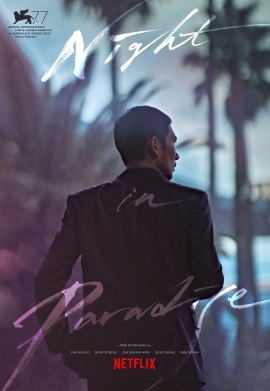
Directed by: Park Hoon-jung || Produced by: Park Hoon-jung
Screenplay by: Park Hoon-jung || Starring: Uhm Tae-goo, Jeon Yeo-been, Cha Seung-won, Lee Ki-young, Park Ho-san, Cho Dong
Music by: Mowg || Cinematography: Kim Young-ho || Edited by: Jang Rae-won || Country: South Korea || Language: Korean
Running Time: 131 minutes
I rewatched Kim Jee-woon’s I Saw the Devil (2010), a famous Korean serial-killer thriller, with my wife the other night and happened to notice a background role played by Uhm Tae-goo, later star of Park Hoon-jung’s Night in Paradise, as a random Seoul police detective and righthand man to police chief Chun Ho-jin, who himself played a serial-killer (spoilers… ) in the 2017 film, The Chase. A couple nights earlier, we had watched Night in Paradise, which, to my knowledge, was Uhm’s first lead role in a major feature-length motion picture, and one of the many filmmaking casualties of the COVID-19 pandemic (the film later debuted on Netflix in early 2021).
Park started his career as the principal screenwriter for I Saw the Devil before later becoming a successful filmmaker himself with such films as The New World (2013) and The Tiger (2015), both of which starred Choi Min-sik (the murderous antagonist of Devil), as well as the half-bonkers, half-stupid sci-fi terror, The Witch (2018, 2022). Night in Paradise is written, produced, and directed by Park, and feels like a sort of stylistic midpoint between the first Witch installment (2018), an awesome film, and the second Witch (2022), a much less awesome film. A classic sort of gangster film shot in the morose, dour, downtrodden visual style of neo-noir crime-thrillers like Blade Runner (1982, 2017), Nicolas Winding Refn’s Drive (2011) and Only God Forgives (2013), John Wick (2014), and of course Oldboy (2003), Paradise describes the twisted, miserable career of gangster enforcer Uhm, whose single-minded talent for violent mayhem destroys everything around him. It’s not an understatement to say that Paradise, while suave and well designed in many respects, is one of the most depressing, miserable crime dramas I have ever seen.
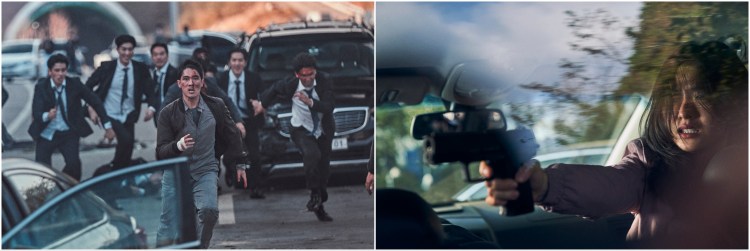
Night in Paradise’s action sequences with male lead, Uhm Tae-goo (left), and female lead, Jeon Yeo-been (right), are strong enough and the overall movie, long enough, that I wish there were more of them.
To be sure, the film doesn’t punish almost without cause the way, say, Rob Jabbaz’s The Sadness (2021) does, but it is just as effective at discouraging a life of crime as Martin Scorsese’s The Departed (2006) and is almost as longwinded. That is also not to say that Paradise is without genre entertainment value given its overall memorable cinematic violence, impressive action sequences, and almost laidback mood thanks to a memorable Jeju Island backdrop (again, this is the guy who did The Witch… ); part of my frustration with something like Paradise, though, is how much more impressive it could’ve been had it streamlined particular story elements or toned down the sheer torture of its protagonist.
With respect to the latter element, Uhm is an effective, relatable lead as the mobster lieutenant of a smalltime Seoul gang with a human heart. The tragic inciting incident that kickstarts his downward spiral leaves a mark given how brutal it feels, and his subsequent bloody act of revenge on behalf of his gangster boss (a despicable Park Ho-san) in a blue-tinted sweathouse contrasts well given its low-key malice. Once Uhm is transferred to Jeju Island as a reward for said bloodshed, the meat of the narrative sees Uhm bond with the young adult niece (Jeon Yeo-been) of a local arms-dealer, but fallout from Uhm’s latest work on the mainland soon follows in the form of the charismatic, intimidating rival, Cha Seung-won.
I don’t mind tragedy in my crime dramas, including dark endings, so long as there’s a narrative point to all the misery at play. The tragic central arc of Paradise is memorable in many good ways, but it’s undercut by one extended sequence in particular that beats Uhm’s protagonist to a pulp, almost literally, going on and on and on and on… with little rhyme or reason to the overchoreographed torture by the scene’s end. On the one hand, a satisfying epilogue later brings that gory, longwinded scene of torture full-circle, but on the other, I’d wager most viewers will be left scratching their heads in bemusement at the thematic point of Uhm and Jeon’s character development. This is not Oldboy, where Park Chan-wook’s entire narrative hinges on lead Choi Min-sik’s manipulation by a seedy, enigmatic web of ironic tragedy, but rather a story about a loyal soldier whose boss fucks him over because of the former’s connections to crooked law enforcement and a few bad chance events. Parts of that narrative deserve praise for their stylish execution, especially given the memorable choice of location, but much of the narrative punishes for the sake of gratuitous “darkness.”
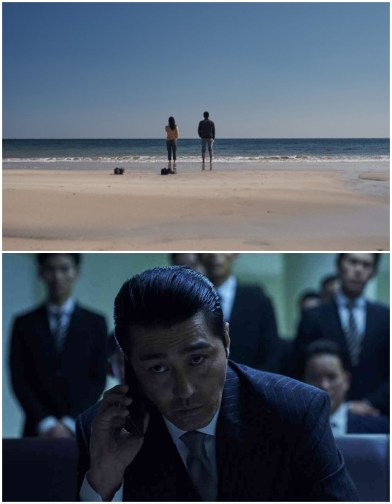
Quieter moments in Paradise’s Jeju Island (top) and mainland (bottom) settings, the latter with charismatic antagonist Cha Seung-won, are impactful enough that you’ll wish they built to a stronger climax.
In hindsight, it’s not difficult to draw artistic connections between Park Hoon-jung’s script work on I Saw the Devil, his grisly direction of The Witch, and the neo-noir lit misery of Night in Paradise. Much of Korean genre filmmaking since the early 2000s has followed in the vein of Park Chan-wook’s morbid Vengeance (2002, 2003, 2005) trilogy, which includes the aforementioned Oldboy, and been better for it, but every now and then, a high-profile Korean feature embraces that macabre tone without fully understanding what to do with it. I’d argue Paradise belongs in that latter category despite how much fun I had with it at times, which makes for an indecisive recommendation that depends on viewers’ tolerance of filmmakers’ dragging their audience-surrogate across hot coals.
——————————————————————————–
SUMMARY & RECOMMENDATION: Night in Paradise feels out of place relative to most Netflix “Original” Films given how its overall tone, noir cinematographic aesthetic, and gritty production values feel characteristic of your average Korean crime drama and film festival darling; its inconsistent plot and unnecessary downer of a conclusion, however, make you question whether its acquisition by the premiere streaming platform was more a function of the coronavirus pandemic or a lack of faith in its general appeal to theatrical audiences.
—> ON THE FENCE; there’s much to like about Night in Paradise, particularly if you’re into mobster flicks, but the film’s unrelenting punishment of its likable characters lacks enough narrative heft to justify the melodramatic ending.
? As a US citizen, the rarity of firearms in these foreign gangster pictures always throws me for a loop. Can’t a brother find a Glock 17, Heckler & Koch Mark 23, or Benelli M4 around here, please?

 Express Elevator to Hell
Discussion
Trackbacks/Pingbacks
Pingback: ‘The Bequeathed’ & ‘A Killer Paradox’ (2024): The Importance of Supporting Characters | Express Elevator to Hell - February 26, 2024
Pingback: ‘The Witch’ (2018, 2022): Genetically Modified Children | Express Elevator to Hell - March 1, 2024
Pingback: The ‘Bourne’ Trilogy (2002, 2004, 2007): Action in the Edit | Express Elevator to Hell - April 8, 2025