
Created by: Isabel Kleefeld || Written by: Isabel Kleefeld, Julian Pörksen
Directed by: Isabel Kleefeld, Julian Pörksen || Starring: Julika Jenkins, Kim Riedle, Naila Schuberth,, Justus von Dohnányi, Haley Louise Jones, Hans Löw, Sammy Schrein, Salli Kurt, Florian Claudius Steffens, Nagmeh Alaei
No. of Episodes: 6 (~280 minutes total)
One of the better independent dramas of 2015 that later became an Oscar favorite at the 88th Academy Awards was Room (2015), directed by Irish filmmaker Lenny Abrahamson and based on Irish-Canadian author Emma Donoghue’s 2010 novel of the same name. Known later as the mainstream breakout of current Hollywood A-lister Brie Larson and child actor Jacob Tremblay, the movie featured a unique two-act structure whereby the first half depicted Larson and Tremblay’s imprisonment inside a domestic hostage cell by kidnapper and rapist Sean Bridgers (Tremblay was the product of this repeated sexual assault, having been born and raised entirely within the eponymous room); the film’s second half detailed Larson and Tremblay’s escape from Bridgers and their grounded, realistic adjustment back into normal society. The film eschewed many hamfisted dramatic cliches common to popular Hollywood filmmaking, such as any sort of final confrontation between survivor and sexual predator (Larson and Tremblay returning to the scene of their capture instead functions as the narrative climax), any courtroom drama a la A Few Good Men (1992), or any elaborate “True Crime“-esque detective work. The point of the story was the liberation and personal transformation of its once imprisoned mother-son duo.
A comparable cinematic take on that sort of freakish crime, yet done in a more conventional crime thriller format, is Isabel Kleefeld’s adaptation of the German novel, Dear Child (2019; “Liebes Kind” auf Deutsch), by Romy Hausmann. Dark and foreboding in tone and gruesome in its visual storytelling, Dear Child plays the material of Room in the style of David Fincher’s Seven (1995) or Gone Girl (2014). Whereas emotional character bonding was the main focus of something like Room, Dear Child pursues a more populist approach while still building memorable, semi-realistic characters atop a darker neo-noir cinematographic style.
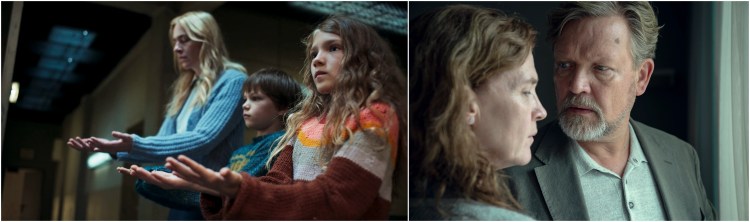
Left: From left to right, Kim Riedle, Naila Schuberth, and Sammy Schrein present their hands for inspection by their captor, as they’ve been conditioned. Right: Julika Jenkins (left) and Justus von Dohnányi (right) are necessary for Dear Child to function, but they are also the series’ weak link.
Perhaps the most unorthodox aspect of Dear Child is how the majority of its 6-episode limited series arc takes place after its principal victims — Kim Riedle as your typical single adult white female, Naila Schuberth and Sammy Schrein as 12 and 9 year-old siblings, respectively, of unknown parentage — are seemingly rescued from an isolated, hidden dungeon armed with a sophisticated security system. Their captor appears to have been subdued, if not killed, during Riedle and Schuberth’s initial escape, and both the hospital staff and law enforcement who discover them quickly deduce they’re kidnappees and that another victim (Schrein) remains unaccounted for. Complicating matters further is how Riedle resembles a 13 year-old missing person’s case of a similar young adult female, the daughter of middle-aged professionals Julika Jenkins and Justus von Dohnányi, who recognize Schuberth as the spitting image of a younger version of said daughter.
Aside from the hunt for Schrein in the hidden rape dungeon throughout the first three episodes, which has a nice ticking clock element and a few, *ahem*, explosive surprises along the way, the primary throughline of the miniseries is the mounting evidence that Riedle, Schuberth, and Schrein’s kidnapper(s) remain at large and may be, in fact, stalking the main castmembers from just beyond the bushes. It’s impressive how principal directors Kleefeld and Julian Porksen maintain tension with this dynamic despite its corniness and some unnecessary melodrama from certain characters (e.g. Jenkins & von Dohnányi), particularly how this tension builds to an unpredictable yet satisfying climax after six quick episodes.
In terms of tone, Dear Child recalls the aforementioned filmography of Fincher and his ilk without ever feeling like a ripoff. Restrained usage of explicit violence and gore heightens foreboding crime scenes where appropriate, which frequently shift to character-focused sequences of the stronger castmembers (e.g. Riedle and Schuberth, police officers played by Haley Louise Jones and Hans Löw) without tonal clash. The blending of the limited series’ grimier crime thriller elements with its intimate character development is so fluid that its depiction of paranoia (e.g. the unknown kidnapper’s voiceover playing as an internal monologue in Riedle’s head) comes across as genuine rather than exploitative.
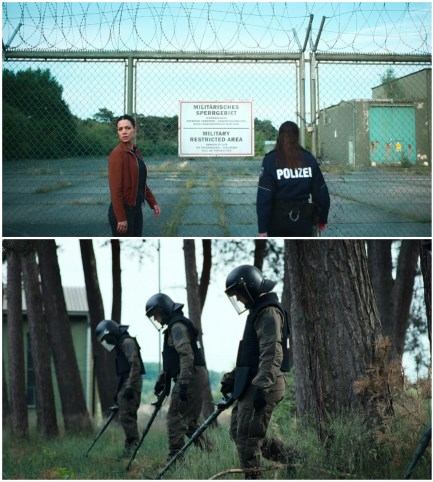
Top: Haley Louise Jones’s lead detective (left) follows clues to the suspected criminal dungeon built by an unknown perpetrator on a decommissioned NATO base. Bottom: A bomb squad combs said base after an unexpected accident.
The only attribute of the series that may turn off certain audiences is the lack of any sustained action or chase sequences. The opening episode sees emergency medical personnel race against the clock to save Riedle, who gets hit by a car during her escape; the second episode ends on a violent cliffhanger; and, of course, the series’ finale ambushes the viewer with a couple sneaky revelations. Other than those brief exceptions, however, Dear Child operates with the mood, tension, and grisly aftermath of crime drama thrills, rather than the acts of such.
In my assessment, the series is better for this restraint given its expert balance of characterizations with monstrous criminality, the latter of which provides melodramatic fuel to propel the narrative forward. Too much outright violence would’ve cheapened Dear Child into a bad knockoff of Korean serial killer thrillers like The Chaser (2008) or Hollywood ones like The Silence of the Lambs (1991), but as is, Isabel Kleefeld and Julian Porksen’s miniseries plays an adept hybridization of Lenny Abrahamson’s Room and a prototypical David Fincher mindbender. Despite the occasional overacted performance, Dear Child succeeds on its atypical narrative structure, mature depiction of implied violence, and tight limited series pacing.
——————————————————————
SUMMARY & RECOMMENDATION: Those with a passion for true crime-inspired/true crime-adjacent fiction a la Dahmer (2022) or the Swedish Millennium (2009) trilogy will find much to like in Dear Child, while those with more reserved, dramatic tastes will find enough deeper character development and understated analysis of sexual assault survivors to sate their demand for social commentary on film. Plus, that ending is — how do the kids say it now? — fire.
— However… like Room’s occasional stilted, overthought dialogue, Dear Child manufactures several conflicts between major characters, the grieving middle-aged couple of Julika Jenkins and Justus von Dohnányi most of all, which feel inappropriate given those characters’ established personalities.
—> RECOMMENDED
? Is this what the German Netflix Original Series Dark (2017-2020) feels like, just without the science-fiction undertones?

 Express Elevator to Hell
Discussion
Trackbacks/Pingbacks
Pingback: ‘The Bequeathed’ & ‘A Killer Paradox’ (2024): The Importance of Supporting Characters | Express Elevator to Hell - February 26, 2024
Pingback: ‘Paradise’ (2023): Age Isn’t Just a Number | Express Elevator to Hell - November 10, 2024