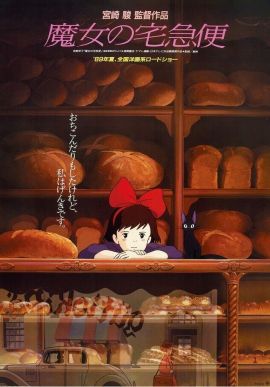
Directed by: Hayao Miyazaki || Produced by: Hayao Miyazaki
Screenplay by: Hayao Miyazaki || Starring: Minami Takayama, Rei Sakuma, Kappei Yamaguchi, Kirsten Dunst, Phil Hartman, Matthew Lawrence
Music by: Joe Hisaishi || Cinematography: Shigeo Sugimura || Edited by: Takeshi Seyama || Country: Japan || Language: Japanese
Running Time: 103 minutes
Two recent film-related YouTube channels I stumbled upon in the past few months are those of Matt Draper and Cleaver Rebooted. I’ll discuss the latter channel at a later date if I ever choose to review the 3-hour, 12-minute Avatar 2 (2022), but for today, let’s note the former author’s favorite films, which he mentions often in his videos: (1) Evil Dead II (1987), his pick for “the greatest movie of all time,” which I have seen but not yet reviewed, (2) Predator (1987), which I have seen many, many times and long ago reviewed, (3) Kiki’s Delivery Service, and (4) Chungking Express (1994), the last two of which I, until recently, had never seen.
Kiki’s Delivery Service (henceforth, KDS), one of the earlier feature films by Hayao Miyazaki and the fourth he directed under his Studio Ghibli banner, feels reminiscent of numerous other Ghibli films from a distance given its coming-of-age format and young, impressionable, yet headstrong protagonist. Its fantasy touches are mild compared to both his earlier works at Ghibli like Nausicaä of the Valley of the Wind (1984) or Castle in the Sky (1986) and his later, more famous projects like Princess Mononoke (1997), Spirited Away (2001), or Howl’s Moving Castle (2004), perhaps most comparable in diegetic tone to the low fantasy of My Neighbor Totoro (1988) from the year earlier. Based on the quasi-episodic novel of the same name by author Eiko Kadono, KDS the feature film is more streamlined than the serialized format of its source material, emphasizing the loneliness common to the teenage experience and those who move away from family for school, their first job, or other important life stages. Kadono’s original work recalls the similarly compartmentalized literary classics of A. A. Milne’s Winnie-the-Pooh (1926) and Rudyard Kipling’s earlier Jungle Book (1894-1895) volumes, which contrast with the stronger dramatic portions of KDS on screen where our titular protagonist encounters serious obstacles like learning her first delivery route, struggling with her flying skills as she ages, as well as her general animosity toward other teenagers in the city to which she moves.
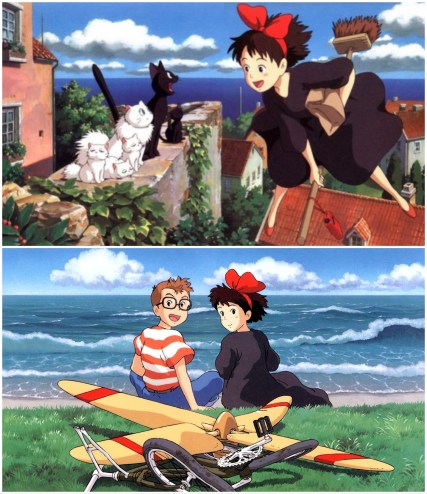
Kiki learns to appreciate the growth of others around her (top) after she learns how to grow a bit herself (bottom).
To back up a bit, KDS is a light — again, not quite as light as the magical realism of Groundhog Day (1993), The Green Mile (1999), Amélie (2001), The Curious Case of Benjamin Button (2006), Synecdoche, NY (2008), Biutiful, Black Swan (both 2010), Life of Pi (2012), Birdman (2014), The Killing of a Sacred Deer (2017), Bardo (2022), etc. — fantasy drama about a 13 year-old witch who’s come of age to leave her home and “set up shop” somewhere else, so to speak (I guess in this world, each town has a resident witch like a supermarket grocer, pharmacy, or mechanic’s garage). She’s as ambitious as most high school graduates nowadays and is eager to explore the world; so, her ritual broomstick flight to the fictional coastal city of Koriko, a sort of mix between a generic Scandinavian port metropolis like Stockholm and sunnier northern California regions like the San Francisco Bay area, leads her to start a quirky small business (today, the kids call it a “startup”) delivering packages with her magical flying abilities.
At the risk of recycling my oft-repeated personal complaints about Japanese animation (anime), my general disinterest in the cute, otherwise likable KDS has nothing to do with its animation style (it’s textural and feels more tangible than your average 2000s-2010s 3D computer-animated feature by Pixar, DreamWorks, Disney, etc.), but rather its lackadaisical, wandering narrative that lacks my beloved cause-and-effect rhythm, as well as numerous plot contrivances meant to manufacture unearned drama. Perhaps Miyazaki struggled (*gasp*, heresy!) adapting the serialized storytelling of the KDS novel, but I can’t help but feel like I’m supposed to gaze in wonder at the animation style whenever the script stalls, which is often.
My discovering that another classic anime recommendation from respected YouTube film critics doesn’t work for me isn’t the most shocking event in my life; I’ll concede that most fans of animation of all stripes or those with more general interests in recent Japanese popular culture (e.g. manga, kaiju movies, samurai trivia, etc.) will be satisfied with Kiki’s Delivery Service. Like most stylized features with vaguely structured narratives, though, I’m not sure how many audiences beyond those specific groups will be riveted by yet another low fantasy coming-of-age story where a girl learns how to solve her rites of passage with magic.
———————————————————————————————————————————————————————————-
SUMMARY & RECOMMENDATION: Most of my chosen YouTube subscriptions have little crossover with the animation world, Western or Eastern, so most critical gushing over the latest Pixar disappointment, Illumination triumph, Spiderverse (2018, 2023) work stoppage, or Studio Ghibli release flies a broomstick way over my head. I would argue that’s for sensible reasons, too, in this case, as films like Kiki’s Delivery Service don’t have so much of a concrete narrative as they do a series of teenage angst highlights elevated by semi-fantastical imagery.
— However… I do appreciate the sequences of Kiki flying, her flight across the countryside in the prologue and her first delivery most of all, while the seaside touches of the primary setting are memorable.
—> ON THE FENCE
? Is that the late, great Phil Hartman (also known as The Simpsons‘ [1989-present] Lionel Hutz and Troy McClure) as Jiji the cat in the English audio track?

 Express Elevator to Hell
Discussion
No comments yet.