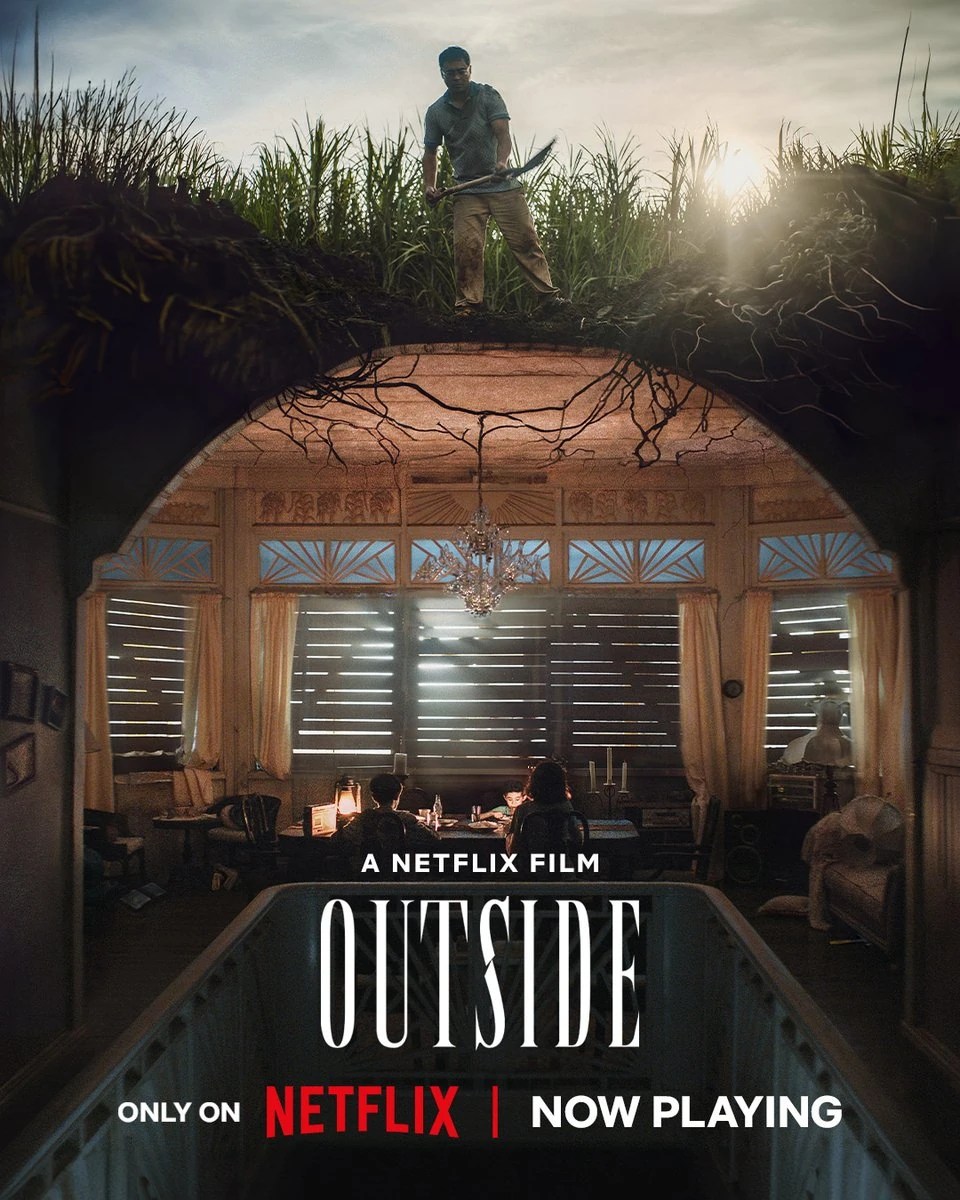
Directed by: Carlo Ledesma || Produced by: Paul Soriano, Mark Victor
Screenplay by: Carlo Ledesma || Starring: Sid Lucero, Beauty Gonzalez, Marco Masa, Aiden Tyler Patdu
Music by: Paul Sigua, Myka Magsaysay-Sigua|| Cinematography: Shing-Fung Cheung || Edited by: Mark Victor || Country: Philippines || Language: Filipino
Running Time: 142 minutes
Certain movies, particularly those limited to one or a handful of locations (e.g. The Platform [2019], Room, The Hateful Eight [both 2015], Cube [1997]), could easily be translated to theatre and are often likened to “stage plays on screen.” Though Quentin Tarantino utilizes slow-motion cinematography, split-focus diopter shots, and and nonlinear editing to make The Hateful Eight as cinematic as possible, conceptually speaking, the screenplay’s small cast and limited locations (90% of the narrative takes place inside a cabin) beg comparisons to theatrical storytelling. Complementary juxtapositions of specific films to theatre may stem from their similar artistic cultures, overlapping professions (e.g. many screen actors and screenwriters begin their careers on stage), and the perceived “artsiness” of cultures like Broadway.
As a rule, I tend to agree with those sentiments because most filmmakers who limit their productions’ geographic scope out of necessity often make the most of those limitations. Structural barriers and limited budgets in the arts can heighten creativity, which is how smaller budgeted and independent cinema compete with expensive major studio productions.
On the other hand, when smaller, auteur-driven cinema is too limited in narrative scope, it can also produce films like Carlo Ledesma’s faux-zombie drama, Outside. The movie, written and directed by Ledesma and featuring a small cast isolated from society a la Night of the Living Dead (1968), irritates me on 2-3 fronts: (1) Its modest narrative scope, repetitive dialogue, and melodramatic performances recall theatrical storytelling at the expense of memorable camerawork and effective pacing; (2) Ledesma writes his two leads (Sid Lucero and Beauty Gonzalez star as husband/father and wife/mother, respectively) to be as unlikable and unsympathetic as possible; and (3) its zombie apocalypse flourishes are so minimal as to be pointless.
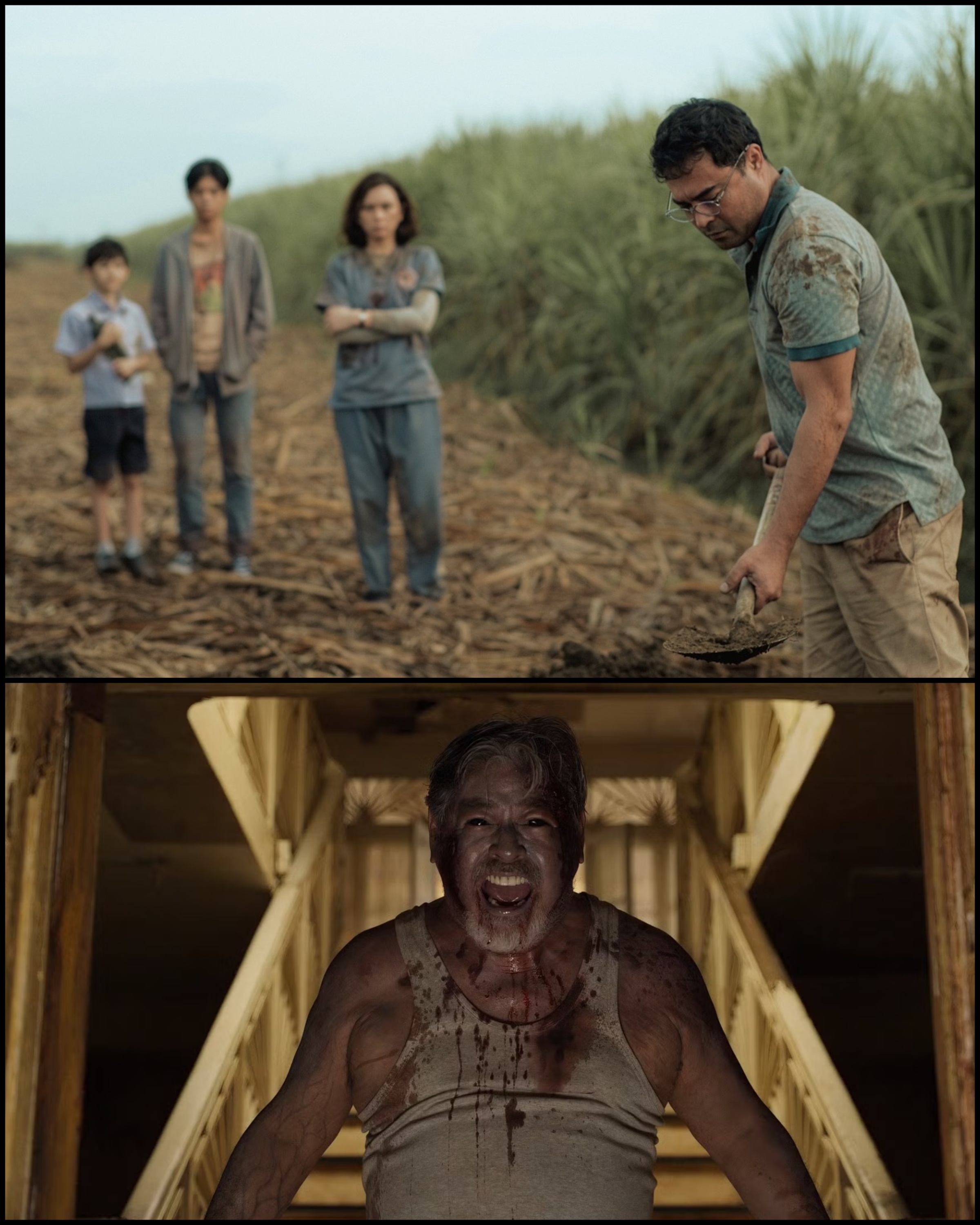
Top: Sid Lucero buries the infected corpses of his parents in their sugarcane fields as his family looks on. Bottom: Numerous on-the-nose nightmares about Lucero’s abusive father punctuate Outside’s narrative.
I’ll cut the movie some slack for the latter point, seeing as how the presence or absence of the walking dead in cinematic fiction is neither an inherently positive or negative attribute (zombie aficionados should acknowledge that the movie has next to nothing to do with zombies, however, as the film’s backdrop could involve any generic disaster corresponding to war, climate change, or non corpse-reanimating pandemic). Whatever leads to its main cast (Lucero, Gonzalez, plus diegetic sons Marco Masa and Aiden Tyler Patdu) sheltering at the ancestral plantation home of Lucero during societal collapse is beside the point. The core of the film is the familial drama that Ledesma believes is captivating enough to hold our attention for almost two and a half hours (142 minutes, to be exact).
With regards to its cartoonish performances and inexcusably narrowminded lead characters, however, my dislike of Outside stems from how it paints Gonzalez as an insufferable, whiny know-it-all who puts her family in needless risk in Act One, and then portrays Lucero as a one-note crazy person seemingly possessed by the ghost of his abusive father in Acts Two and Three. Viewers over the age of twelve will immediately discern the overarching commentary on generational trauma and parents replicating the abusive behaviors they suffered under their own parents; yet my primary criticism of Outside is how simplistic its portrayal of those dynamics are. Ledesma writes Lucero and Gonzalez to be so unreasonable despite their external life-or-death situation that Outside’s emotional conflict feels simplistic and dumb.
Aspects of Ledesma’s directorial style are similarly lacking but minor (e.g. computer generated explosions, obtuse montage edits) or insufferable (re: the aforementioned punishing runtime). Cinematographically speaking, Outside lacks the stylistic charm of Tarantino’s Hateful Eight or Vincenzno Natali’s Kafkaesque Cube.
That weak directorial style leaves Outside to live and die by the charms of its theatricality, which, as stated ad nauseum at this point, are not effective. Outside has few mainstream critical reviews as of this writing (November 2024), but I suspect its current decent positive/negative ratio stems from most Anglophone critics grading overseas genre films on a curve (see also Jawan, Animal, The Three Musketeers [all 2023], Troll [2022], Saloum [2021]). Carlo Ledesma’s rendition of a Filipino post-apocalyptic family melodrama has enough ties to theatre to markets itself as a slow-burn, “artsy” stage play, and unfortunately it has enough self-serious, heavy-handed storytelling to match.
———————————————————————————————————————————————————————————
SUMMARY & RECOMMENDATION: As stimulating on the intellect as it is exciting to watch, Outside by Carlo Ledesma paints a theatrical, not cinematic portrait of generational family trauma about as subtle as a sledgehammer to the face. Unrelatable lead characters, loud performances, an inexplicable running time, and forgettable visual direction make Outside one of the worst non-English language Netflix Original Films I’ve seen in a while.
—> NOT RECOMMENDED
? If Lucero was so traumatized by his father’s abuse in his childhood home, would he not, psychologically, want to get as far away from it as possible?

 Express Elevator to Hell
Discussion
No comments yet.