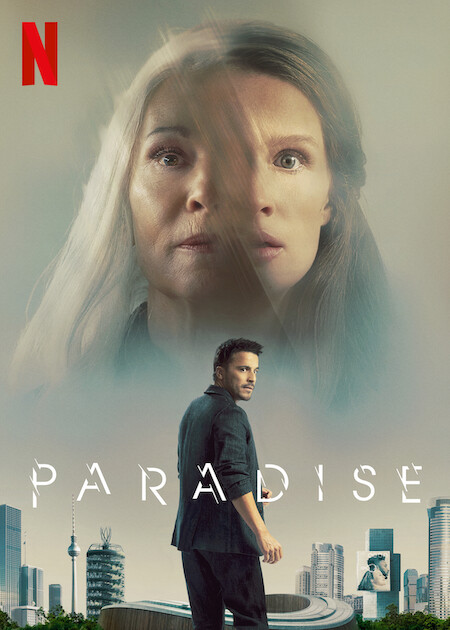
Directed by: Boris Kunz || Produced by: Nathalie Bouteiller-Marin, Nina Kammermeier,
Screenplay by: Simon Amberger, Peter Kocyla, Boris Kunz || Starring: Kostja Ullmann, Corinna Kirchhoff, Marlene Tanczik, Iris Berben, Lisa-Marie Koroll, Lorna Ishema, Numan Acar, Alina Levshin
Music by: David Reichelt || Cinematography: Christian Stangassinger || Edited by: Max Fey || Country: Germany || Language: German
Running Time: 117 minutes
As I have tried to expand my blog coverage across as many different cinematic cultures as possible, I have noticed a dearth of contemporary German features on mainstream subscription video-on-demand (SVOD) platforms like Netflix relative to other prominent European film industries. French and Spanish Netflix Original Films, for example, are easy to find on the premiere SVOD service, while popular German properties that have broken into the Anglosphere appear limited to the time-traveling series cousin to Stranger Things (2016-2025), Dark (2017-2020).
Ever since my positive reactions to Peter Throwarth’s Blood Red Sky (2021) and Edward Berger’s All Quiet on the Western Front (2022), though, I’ve kept my eyes pealed for notable modern properties available on Netflix (e.g. 60 Minutes [2024], Dear Child [2023]) or older classics (e.g. Run Lola Run [1998], Das Boot [1981], Downfall [2004]) from the German-speaking world. Most of the recently produced films I’ve seen, however, have been a comedown from Blood Red Sky and All Quiet, perhaps due to a lack of homegrown industry funding or competition from abroad. The average 2020s German feature I’ve seen, for example, has been more akin to the well meant but amateurish Prey or The Colony (both 2021) than the gonzo action-heist-horror extravaganza that was Blood Red Sky.

Marlene Tanczik, wife of protagonist Kostja Ullmann, is mandated to give 38 years of her life to an unknown but likely far wealthier recipient in the powerful first act of Paradise.
Enter Paradise, a speculative science-fiction piece from cowriter-director Boris Kunz, a filmmaker I’ve never heard of and whose Internet Movie Database profile consists mostly of broadcast television shows. Like many non-English language Netflix Original Films, Paradise is a pulpy genre movie designed to appeal across cultures and language barriers thanks to its high-concept premise: In a not-too-distant future, ominous technology from an unscrupulous corporation allows donors — often refugees or those of lower socioeconomic status — to sell years of their life to often wealthier “recipients” who are a genetic match. After our protagonist (Kostja Ullmann) and his wife (Marlene Tanczik at first, then later Corinna Kirchhoff) fall into severe debt thanks to a series of improbable unfortunate events, the latter is legally coerced into selling decades of her life to an unknown match.
This film’s starting point most reminded me of that schlocky Hollywood science-fiction film starring Justin Timberlake, In Time (2011), but Paradise trades the latter’s heavy-handed storyline for a more dramatic contemplation on the morality of selling not just one’s fluids (e.g. blood, plasma) or organs, but entire lifeforce to the well off. This classical haves vs. the have-nots storyline will be familiar to general audiences, although I give Kunz and primary screenwriters Simon Amberger and Peter Kocyla credit for not taking the lowest common denominator approach; the movie’s primary villain (Iris Berben) is not a mustache-twirling cartoon character and its audience surrogates are not working-class heroes without flaws; all characters are portrayed as somewhat relatable, two-dimensional figures with motivation to drive the plot forward, and prevent the film’s conclusion from being wholly predictable.
On the other hand, Paradise struggles with a limited budget and misguided attempts at action set-pieces, the latter of which dominate the movie’s sizeable 117-minute runtime after the halfway mark. The movie’s location photography in Berlin in the first act is memorable, mixing rundown, dilapidated neighborhoods with more scenic landmarks augmented with sufficient yet not overwhelming computer generated imagery. Once the movie’s setting and production moves to Lithuania, however, you can tell the movie ran out of money as the sets get cheaper and the dialogue sequences become talkier; the fast-paced, efficient exposition of the first act give way to characters rehashing the same conversation over and over, with the mystery of a certain minor castmember’s identity not generating the tension that the filmmakers clearly anticipated it would. Worst of all may be the film’s “action” sequences, which lean too hard into the script’s subplot about armed guerilla forces hellbent on assassinating the primary corporate antagonists. An uninspired long-take during one of these shootouts late in the third act left me scratching my head most of all.
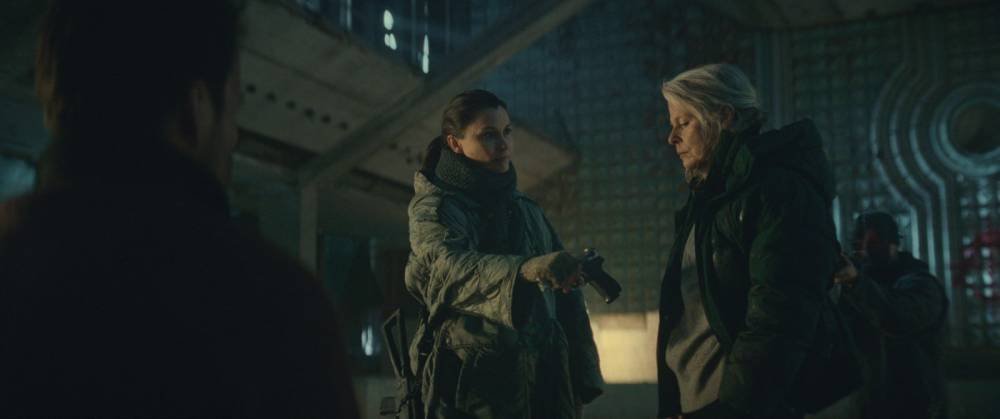
Lisa Loven Kongsli (center left) stars as an extremist opposed to Paradise’s lifeforce-trading corporation; and offers Corinna Kirchhoff (center right) a heavy-handed chance for vengeance against them.
In other words, Paradise starts strong and appears to have a decent script, at least in its first half, but its limited budget frontloads the movie’s most interesting cinematography, locations, and overall production values. It is difficult to understate how drab the latter half of the movie looks and feels in a bad way despite a couple memorable character moments late in the third act. I would never call the work here by Boris Kunz lazy by any means, but as the film stands, it is 1/2 of a good movie and 1/2 a cheap 2000s-era television episode with a high-concept premise. Like many of the other German properties I’ve explored on Netflix of late (e.g. Old [2022]), it has good ideas but can’t quite nail their execution throughout its runtime.
——————————————————————————————————————————————————————————-
SUMMARY & RECOMMENDATION: Despite a rich filmmaking history that stretches all the way back to its Expressionist era, contemporary German filmmaking appears underrepresented on the higher-profile SVOD platforms compared to the likes of French, Spanish, or even Nordic filmmaking today. Films like Paradise may be a partial explanation as to why, given their potential lack of sufficient funding for expansive genre productions and inconsistent execution of a clear cinematic vision. Paradise jumps out of the gate with its memorable premise and screenwriting maturity, but gets distracted by lackluster action sequences and an overall lame second half.
— However… I appreciate how the movie never treats its main characters as mouthpieces for its screenwriters’ politics, nor portrays them as one-dimensional caricatures. The opening act of Paradise also deserves special FX praise for its convincing portrayal of a plausible dystopia.
—> ON THE FENCE; Paradise is worth a watch if you already subscribe to Netflix, but otherwise I wouldn’t expend effort seeking it out.
? What finally convinced Corinna Kirchhoff to do the deed? The fact that Lisa-Marie Koroll actually pulled the trigger, or the overarching conspiracy behind her situation… ?

 Express Elevator to Hell
Discussion
Trackbacks/Pingbacks
Pingback: Hindi Indies, Volume 2: ‘Haseen Dillruba’ (2021, 2024) & ‘Dhoom Dhaam’ (2025) | Express Elevator to Hell - May 25, 2025