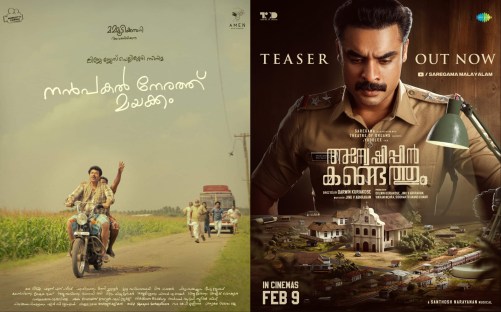
Directed by: Lijo Jose Pellissery [1], Darwin Kuriakose [2] || Produced by: Mammootty [1], Darwin Kuriakose, Dolwin Kuriakose, Jinu V Abraham, Vikram Mehra, Siddarth Anand Kumar [2]
Screenplay by: S. Hareesh [1], Jinu V. Abraham [2] || Starring: Mammootty, Ramya Pandian, Ashokan [1], Tovino Thomas [2]
Music by: N/A [1], Santhosh Narayanan [2] || Cinematography: Theni Eswar [1], Gautham Sankar [2] || Edited by: Deepu S. Joseph [1], Saiju Sreedharan [2] || Country: India || Language: Malayalam [1, 2], Tamil [1]
Running Time: 104 minutes [1], 145 minutes [2] || 1 = Nanpakal Nerathu Mayakkam, 2 = Anweshippin Kandethum
Contemporary (2010s-2020s) Malayalam-language movies of the southernmost Indian state of Kerala are something of an enigma to me. Unlike the populist, romantic musical melodramas of the Mumbai (formerly Bombay)-based studios of Hindi Cinema, also known as Bollywood, or the edgier, action-packed masala blockbusters of their South Indian Cinema neighbors (Telugu, Tamil, and Kannada-language films), most successful films borne of Kerela that I’ve sampled feel notable for their quiet reservedness. How low-budget — not necessarily low-quality, but humble in production scope — they appear via their almost universal on-location photography (typically a positive), small casts, and intimate focus on everyday rural village life (can be positive, neutral, or negative) is a large part of their charm. On the one hand, I like how antithetical these types of films are to the broad, often bland tone of bigger budgeted mainstream films focus group-tested to appeal to as wide an audience as possible, yet on the other, the genre (e.g. action, science-fiction, horror, thriller) fan in me wishes for a bit more “spice,” for lack of a better term, in these stories. The most extravagant modern Kerala screenwriting formula gets is the odd crime drama or murder mystery now and then.
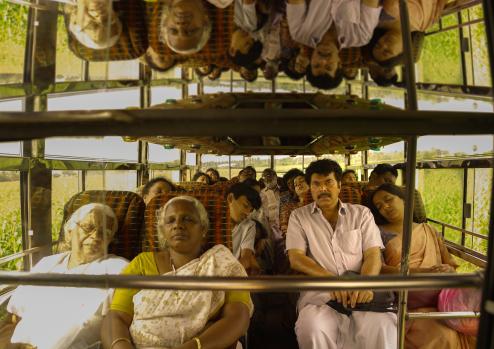
In a nice visualization of Nanpakal Nerathu Mayakkam’s themes of duality and identity, a tour bus’ glass reflects the image of our main cast of passengers (note lead Mammootty in white at center right in the foreground).
Two good examples of this Malayalam-language formula are the 2022 and 2024 films of Nanpakal Nerathu Mayakkam (“Like An Afternoon Dream”) and Anweshippin Kandethum (“Seek, and You Shall Find”), respectively. Both are modest in narrative stature yet creative in filmmaking style, sporting most all the aforementioned characteristics of contemporary Malayalam cinema that make many quasi-independent American films (see films by Lionsgate, A24, Sony Pictures Classics, etc.) feel epic in scale by comparison. The first, Nanpakal Nerathu Mayakkam (henceforth, NNM), is built around the quirky, very arthouse premise of a disgruntled, closeminded family man (Muhammad Kutty Panaparambil Ismail, or Mammootty for short) on a tour bus from Tamil Nadu traveling back to his native Kerala who awakens from a nap believing he’s another person; Anweshippin Kandethum (AK), a police procedural crime drama, follows a sub-inspector’s (Tovino Thomas) investigation of two different intriguing, yet disconnected homicides that happen to conclude in the same fate for both culprits. Each film embodies the stereotypical quiet drama of all the other Malayalam films I’ve watched thus far.
With regards to the first picture, NNM sports a more identifiable, memorable cinematographic style than AK despite the former’s straightforward dramatic approach with the tiniest of magical realist twists. The vast majority of the first two acts is captured in wide shots on locked down, static cameras that would impress even David Fincher’s aversion to handheld camerawork but not, I suspect, his editors’ rhythm of montage. Despite its concise length of 104 minutes, NNM feels almost twice that length thanks to the sheer repetition of its visual style and an almost complete lack of non-diegetic music. The realistic, relatable performances of the ensemble cast aid this fly-on-the-wall documentarian aesthetic, though most characters’ reluctance to directly challenge Mammootty’s weird behavior frustrated my viewing of the film given the story’s otherwise grounded tone.
The lone element of NNM that strays from that groundedness is the ambiguous, perhaps surrealist portrayal of how Mammootty awakens toward the end of the first act believing he is a different person. In fact, the character halts his fellow passengers’ bus trip, strolls through the cornfields to the nearest Tamil village, and assumes the identity of a long missing patriarch there, even going so far as to walk into that presumably deceased man’s house to act as him and speak fluent Tamil within a few scenes. How the stunned local villagers and confused, angry bus tourists react to this scenario forms the bulk of the film’s narrative, though its ultimate conclusion left me unsatisfied.
Longer-winded as the typical Indian movie of any language and shot in a more conventional style is AK. AK’s greatest strengths and weaknesses intertwine with its twin murder mysterious spread over its inexplicable dual act structure, which more or less sandwiches two unrelated, standalone police investigations into a single feature that’s nearly two and a half hours long (145 minutes, to be exact). I don’t know whether screenwriter Jinu V. Abraham had two shorter, 65-70 minute-long scripts that director-coproducer Darwin Kuriakose liked but had to shoot back-to-back on a single limited budget, or whether this oddball story format emerged organically from Kuriakose. Either way, AK is no Casino Royale (2006), another movie with a non-traditional screenplay, as its entertaining whodunit plots satisfy enough on their own but make little sense as a singular, cohesive narrative; AK overall feels like two episodes of a dialogue-heavy television show smooshed together without providing a worthwhile epilogue for either criminal mystery.
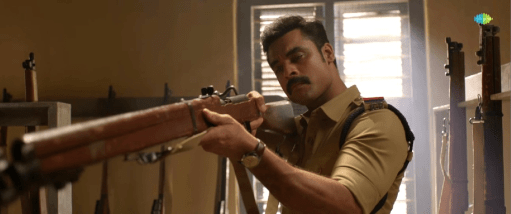
Lead Tovino Thomas of Anweshippin Kandethum tests a British colonial era rifle in between his detective duties.
The upsides of both of these films — the enticing, creepy homicides of Anweshippin Kandethum and the often charming road movie culture shock of Nanpakal Nerathu Mayakkam — are unique enough that I can’t dismiss either film out of hand. I imagine the average Malayalam cinephile will appreciate their execution of the now customary small scale, rural aesthetics of Kerala’s film industry, but I’d argue they have either enough photographic (Nanpakal Nerathu Mayakkam) or storytelling (Anweshippin Kandethum) inconsistencies that they may not play well enough outside their home cultures.
———————————————–
SUMMARY & RECOMMENDATION: Charming in their own audiovisual way that other types of Indian cinema can’t replicate, be it the bombastic melodrama of Bollywood, the stylish genre pulp of popular Telugu and Tamil filmmaking, or the boring stuff from West Bengal, this pair of Malayalam dramas take advantage of their memorable location photography and laid back, realistic characters to portray memorable rural ballads of South Asian village life.
— However… that small-town Indian charm wears off to a certain degree with Nanpakal Nerathu Mayakkam’s commitment to wide-shot, wide-angle, static camerawork and an awkward transition between Anweshippin Kandethum’s two disconnected acts. If you break the rules of filmmaking, you must first master them.
—> I remain ON THE FENCE with respect to both films.
? Anweshippin Kandethum can’t fool me with that computer generated rain, which stands out like a sore thumb in its final shot.

 Express Elevator to Hell
Discussion
Trackbacks/Pingbacks
Pingback: ‘Ratsasan’ (2018) & ‘V’ (2020): What Genre(s) Are Serial-Killer Movies? | Express Elevator to Hell - May 30, 2024
Pingback: ‘Pushpa’ (2021, 2024): The Rise & Rule of Telugu Blockbusters | Express Elevator to Hell - March 20, 2025