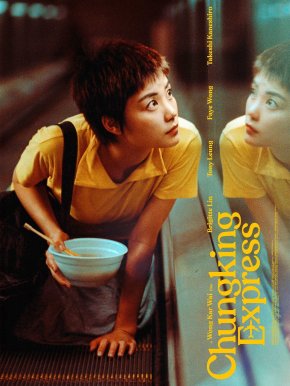
Directed by: Wong Kar-wai || Produced by: Chan Yi-kan, Jeffrey Lau
Screenplay by: Wong Kar-wai || Starring: Brigitte Lin Chin-Hsia, Takeshi Kaneshiro, Tony Leung Chiu-Wai, Faye Wong
Music by: Frankie Chan, Roel A. Garcia || Cinematography: Christopher Doyle, Andrew Lau || Edited by: William Chang, Kai Kit-wai, Kwong Chi-Leung || Country: Hong Kong || Language: Cantonese
Running Time: 98 minutes
Wong Kar-wai is perhaps the Hong Kong filmmaker with whom I have the most contentious parasocial relationship as a cinephile. I included him on my Five Overrated Filmmakers list, one of the earliest and orneriest film analysis essays on this blog, and haven’t taken him off since. Does that mean I still hold him in a contrarian’s low esteem after all these years, or am I just too lazy to revisit a number of my older blog posts? Yes!
One could be forgiven for thinking I hold most films that aren’t either (A) creature-features/monster movies/alien invasion flicks or (B) hardcore shoot-’em-up action movies with contempt, as I’m not shy about shitting on (1) Hollywood Oscar-bait, (2) loud, dumb, digital FX-heavy blockbusters, (3) Japanese animation, or (4) Chinese wuxia martial arts movies (Cantonese ones included) whenever necessary. While my least favorite cinema often fit into one or more of those aforementioned (1-4) categories, I always mean it when I say I give all types of cinema a fair shake at their outset and always reflect upon my own biases with respect to the former two (A-B) groupings; I try to be as objective of a movie reviewer as possible, at least in writing.
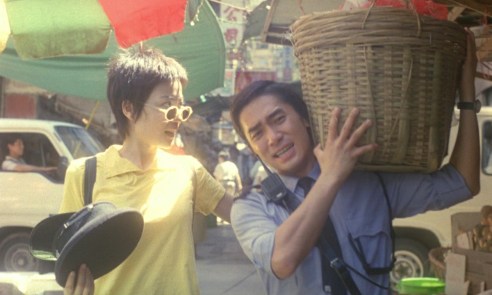
In Chungking Express’ second narrative, Faye Wong (left) flirts Tony Leung (right) into carrying her laundry. You know, the classic.
With regards to my mixed reactions to the heydays of Hong Kong action cinema (1970s-1990s), I’ll always respect Jackie Chan’s dedicated stuntwork and perfectionist action cinematography, and few cinephiles love John Woo‘s or Johnnie To‘s filmographies more than I — though again, their action genre bent may fit my personal biases better, so who knows? My attitude toward the moody, steamy, esoteric dramas of Wong, however, has not changed a great deal since I started this amateur website over a decade ago, which I believe results from several attributes endemic to his filmmaking style that are exemplified in his 1994 classic, Chungking Express.
Express is named after the partitioned Chungking Mansions building in the famous southern Hong Kong neighborhood of Tsim Sha Tsui, where Wong hails from, as well as a featured takeout restaurant in the central part of the city, Midnight Express. The film consists of two disconnected mid-length (~45 minutes) episodes that have nothing in common with each other besides a couple minor characters (e.g. Chan Kam-Chuen as the manager of the titular restaurant), vague overarching themes about longing for romantic connection, a couple shared filming locations around the principal takeout establishment, and the fact that each episode’s lead character is a cop.
In the first story, detective Takeshi Kaneshiro copes with a recent breakup by frequenting the Express stand’s payphone to call old female contacts out of desperation, though he later becomes infatuated with Brigitte Lin Chin-Hsia’s mysterious black market smuggler. Lin dresses in a distinctive blonde wig when she’s gunning down Indian migrant workers and Western club owners who double-cross her, but it’s somewhat difficult to decipher her actions when cinematographers Christopher Doyle, a longtime collaborator of Wong’s, and Andrew Lau of later Infernal Affairs (2002) fame, crank the framerate down to around 8-12 frames per second (fps) to create a disorientating, dreamlike haze that has now come to define Wong’s broader filmmaking style.
Sometimes this “step-printing” technique — a combination of ultralow fps and duplicating or triplicating each shot that results in a herky-jerky series of freeze-frame jump-cuts of a sort — works better in the film’s second storyline, where Tony Leung Chiu-Wai’s beat cop deals with his own recently ended relationship by flirting with singer-songwriter Faye Wong’s Express employee. As the two become acquainted, Faye enmeshes herself secretly into Leung’s life by stalking him, breaking into his apartment, and performing odd chores around the house a la Amélie (2001; Wong should sue!). The emotional disconnect between Leung and Faye to their environment feels like more appropriate material for the above referenced framerate manipulations and eclectic pop soundtrack than the drug running subplot of Part I, for what it’s worth.
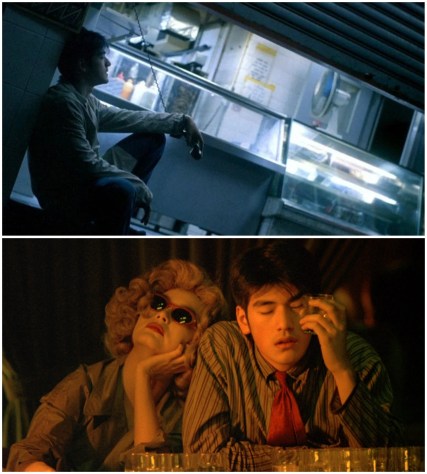
Tony Kaneshiro is exhausted both when alone (top) and with company (bottom, with Brigitte Lin on the left) in the first story of Express.
It almost goes without saying at this point that you don’t watch Wong Kar-wai’s filmography for the story, but instead for the seductive mood, oddball camerawork, and lonesome characters that clearly remind Wong of certain figures from various romantic literature he read in his youth. His weird, eclectic mix of an almost MTV-esque audiovisual style with fragmented, dreamlike narratives, which is on full display in Chungking Express, either works for you or it doesn’t. The improvisational, opportunistic nature of the film’s performances (Wong shot Express without a finished script, as is typical for his movies) comes across in the main characters’ numerous amusing, neurotic habits they demonstrate (e.g. Kaneshiro binge-eating 30 cans of pineapple; Leung talking to various inanimate objects around his apartment), and while I can respect this unabashed display of cinematic personality, I still argue a captivating story that does not make.
————————————————————————
SUMMARY & RECOMMENDATION: Given the odd disconnect yet tonal repetition between Chungking Express‘ two halves, I wonder if the film would’ve been better served as either an anthology told across 4-5 shorter stories that were better interlinked, or as a singular plot built around a smaller cast with more experimental, psychedelic camerawork (think Enter the Void [2009], but with likable characters). The film as is comes across like an interesting yet half-baked romantic drama concept that’s primarily a function of Wong’s nostalgia for physical iconography with which he identified growing up.
— However… Wong’s step-printing choices at least give Chungking Express an identifiable style, and his characters are sympathetic. That soundtrack is bouncing.
—> ON THE FENCE; romantic cinephiles longing for 1990s Hong Kong noir with minimal violence will like this one; all others can pass, though.
? Would that handwritten boarding pass work in those days, or was it more of a travel suggestion?

 Express Elevator to Hell
Discussion
Trackbacks/Pingbacks
Pingback: ‘Dear Child’ (2023): ‘Room’ (2015) Meets a German David Fincher | Express Elevator to Hell - September 11, 2023
Pingback: More Malayalam Movies: ‘Nanpakal Nerathu Mayakkam’ (2022) & ‘Anweshippin Kandethum’ (2024) | Express Elevator to Hell - April 30, 2024
Pingback: ‘The Pig, the Snake, & the Pigeon’ (2023): Go Out With a Bang | Express Elevator to Hell - June 10, 2024