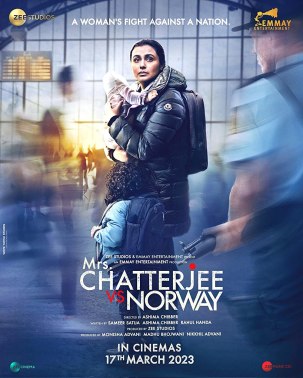
Directed by: Ashima Chibber || Produced by: Monisha Advani, Madhu Bhojwani, Nikkhil Advani
Screenplay by: Sameer Satija, Ashima Chibber, Rahul Handa || Starring: Rani Mukerji, Anirban Bhattacharya, Neena Gupta, Jim Sarbh
Music by: Amit Trivedi || Cinematography: Alvar Kõue || Edited by: Namrata Rao || Country: India || Language: Hindi
Running Time: 144 minutes
I found it coincidental and more than a little ironic how, not long after I dipped my toe into Norwegian cinema (e.g. Roar Uthaug’s The Wave [2015] and Troll [2022]), including a nontraditional supernatural thriller told from the perspective of child characters (The Innocents [2022]), Ashima Chibber’s sophomore feature, Mrs. Chatterjee vs Norway, popped onto my Netflix feed after a brief run in select theatres this past March. Detailing the international controversy over the Norwegian state’s Child Welfare Service’s (CWS; “Barnevernet,” or literally “child protection” in Norwegian, renamed as “Velfred” within the film) removal of two young children from a Bengali-Indian immigrant family in 2011, Mrs. Chatterjee vs Norway (henceforth, MCN) flaunts its real-life firebrand subject-matter like the most self-serious, melodramatic Hollywood Oscar-bait or, perhaps more accurately, the preachiest Bollywood crowdpleaser. The film’s source material feels more fascinating in many ways than the film itself given its inexperienced director (Chibber’s directorial debut, Mere Dad Ki Maruti [2013], released over a decade prior to similar mediocre reviews and meager box office returns), Rani Mukerji’s over-the-top lead performance, and the simplistic screenplay, the latter credited to no less than three screenwriters, including Chibber, which is a shame given the diplomatic row this child custody case prompted and the many intercultural, marital, and parental rights issues that intersect throughout the film’s premise.
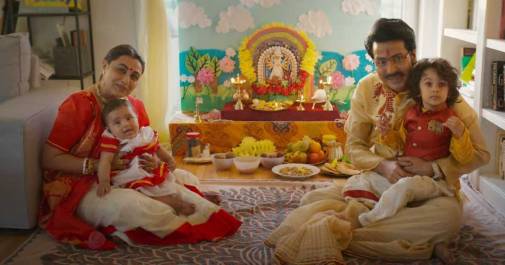
Mrs. Chatterjee vs Norway is at its strongest when it examines the tumultuous relationship between its title character (Mukerji) and costar Anirban Bhattacharya.
To save readers a moderate amount of background research, MCN dramatizes the he-said/she-said true story of Sagarika Chakraborty and Anurup Bhattacharya’s legal battle against Norwegian CWS for custody of their children, which the Indians claim was a function of Western ignorance of common South Asian customs (e.g. handfeeding children, children co-sleeping with parents, etc.); the Norwegian government, in turn, argues the parents’ toxic relationship led to violence within the household and possible corporal punishment of their kids. Both Chakraborty and the film allege serious physical abuse by Anurup against her, and the pair soon separated after returning to India once Barnevernet granted custody to Bhattacharya’s family in a sort of legally murky, still as of this writing, ambiguous compromise. Both children eventually returned to the guardianship of their mother after further legal debate in Calcutta, where they remain to this day.
If that sounds like a mouthful of real-life controversy for a feature film to devour, you’re not wrong, and this bonkers roller-coaster of an international legal quagmire does much for MCN’s entertainment value however much its simplistic, amateurish writing devolves the true-life source material into heavy-handed melodrama. Families, parents, children, social introverts, those who hate kids, and independent loners will find this premise hard to ignore given its aforementioned sociopolitical fallout, like the cultural exchange equivalent of a trainwreck you can’t look away from. From the first act to the last scene, Chibber, to her credit, maintains a level of narrative tension that permeates throughout the main cast’s performances and every single dramatic courtroom sequence. The complicated relationship between Mukerji’s titular Chatterjee (a fictionalization of Chakraborty) and supporting actor Anirban Bhattacharya (the dramatized version of Chakraborty’s husband and the latter actor’s Hindi debut) is built atop their effective chemistry, feeling nuanced in a way the rest of the story doesn’t.
Speaking of that lack of nuance, MCN’s stumblings are tied to Mukerji’s bad English dialogue and histrionics, as well as the narrative’s comical one-note depiction of its Norwegian antagonists. Mukerji’s protagonist is portrayed as more or less monolingual, so her cartoonish, stilted, awkward performances opposite the Western cast are cringeworthy; by the same token, employees of the Velfred/Barnevernet organization come across like mustache-twirling villains from a 1990s Disney animated film whose creepy, Pennywise-esque makeup, devious laughter, and caricatured acting contrast with the on-the-nose flashback montages of Mukerji hugging her children with all the subtlety of a sledgehammer.
I suspect that Mrs. Chatterjee vs. Norway will (1) help India’s increasingly nationalist population feel even more confident in their perceived cultural superiority relative to the West, (2) make non-resident Indians think twice before moving to highly developed Nordic countries, and (3) draw further attention to the numerous international controversies over Norway’s Child Welfare Service, the latter of which may well be deserved. As a polemical device, I think Ashima Chibber’s latest feature shouldn’t be overlooked.
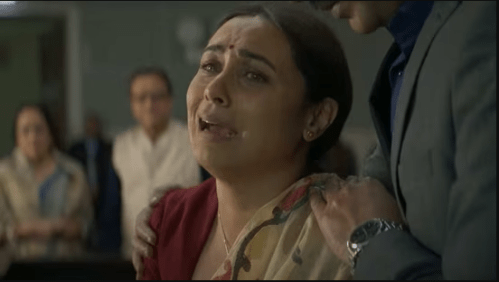
While I, as a parent, can empathize with the sheer panic one would feel in reaction to losing their children, Rani can’t sell her protagonist’s torment beyond shallow theatrics.
None of those factors have much to do with how effective of a movie Mrs. Chatterjee vs. Norway is, however, a dynamic that recalls my consistent ho-hum reactions to so many “important,” socially conscious films that Hollywood produces every year for high-profile awards ceremonies. I’ll give Ashima Chibber credit for her directorial nerve to grapple with such juicy yet touchy subject-matter, as well as an interesting, rare depiction of a multilayered toxic marriage in Hindi cinema, but altogether her film drowns its central premise in a deluge of bad dialogue, loud, exaggerated performances, and hamfisted melodrama.
————————————————-
SUMMARY & RECOMMENDATION: As much as the film annoys me, it’s difficult to deny the pull of Mrs. Chatterjee’s true to life source-material given that material’s inherent drama. When the film focuses on how this affected an already flawed marriage between its two leads (Mukerji and Bhattacharya), the film ain’t bad.
— However… it’s difficult to take the movie’s narrative too seriously when it portrays half its cast as cartoon characters and its courtroom drama as a simplistic black-and-white struggle between good and evil; Mukerji overacts whenever she’s not opposite Bhattacharya.
—> ON THE FENCE
? Funnily enough, a recent case of child protective services challenging parental guardianship here in the United States began with an Indian doctor.

 Express Elevator to Hell
Discussion
Trackbacks/Pingbacks
Pingback: ‘Maharaj’ & ‘Maharaja’ (2024): South Asian Social Justice on Screen | Express Elevator to Hell - July 31, 2024